How to Choose the Right Centrifugal Pump for Industrial Applications
Selecting the right pumping equipment is an important part of maintaining efficient industrial operations. Industries depend on reliable fluid transfer systems to move water, chemicals, oils and other process liquids between different stages of production. Among the available pumping solutions, the centrifugal pump is widely used because of its adaptable design and ability to handle continuous liquid transfer requirements.
However, not every centrifugal pump is suitable for every application. Factors such as flow rate, operating pressure, liquid characteristics and installation conditions influence pump selection. Understanding these factors helps industries identify equipment that meets their operational requirements while maintaining efficiency and reliability.
Why Are Centrifugal Pumps Widely Used in Industries?
A centrifugal pump uses rotational energy to move liquids through a piping system. Its operating mechanism makes it suitable for applications that require continuous fluid movement.
These pumps are commonly found in manufacturing facilities, water treatment plants, chemical processing units, agricultural systems and commercial infrastructure.
Some reasons industries prefer centrifugal pumps include:
Continuous liquid transfer for different industrial processes.
Availability in different capacities and configurations.
Adaptability to various liquid handling requirements.
Relatively simple operation and maintenance.
Compatibility with different construction materials.
Suitability for a wide range of industrial installations.
The actual performance depends on selecting the correct pump design and operating it within its recommended conditions.
Important Factors to Consider When Selecting a Centrifugal Pump
Choosing an appropriate centrifugal pump requires an understanding of the application and its operating requirements. The following factors should be evaluated before selecting a pumping system.
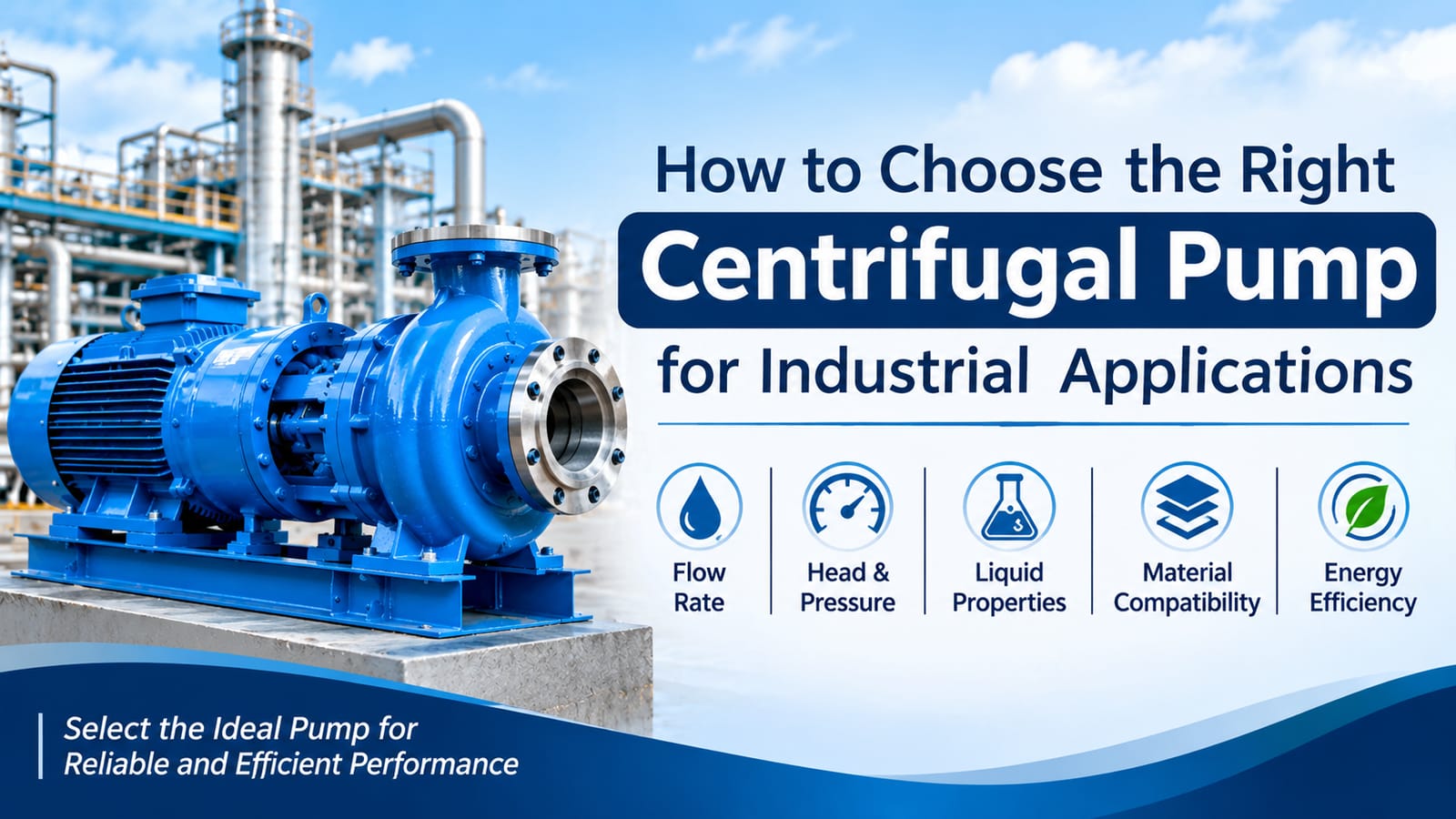
1. Required Flow Rate
Flow rate refers to the volume of liquid a pump must transfer within a specific period. Industrial applications may require different flow capacities depending on production requirements.
For example, a water circulation system may require a different flow rate compared with a chemical transfer operation. Selecting a pump with an appropriate capacity helps maintain consistent process performance.
2. Total Head and Operating Pressure
Total head represents the energy required to move liquid through the complete pumping system. It includes the elevation difference, pressure requirements and friction losses within the piping network.
Understanding the required head helps identify a pump that can deliver the expected flow under actual operating conditions.
3. Liquid Properties
The characteristics of the liquid being transferred directly influence pump selection.
Important properties include:
Liquid viscosity and density.
Operating temperature.
Chemical composition.
Corrosive characteristics.
Presence of suspended solids.
For example, handling corrosive chemicals may require specialised pump materials, while liquids containing solids may need a suitable impeller and casing arrangement.
4. Material Compatibility
Pump construction materials should be selected according to the liquid and operating environment.
Cast iron, stainless steel, polypropylene and other engineering materials are used in different pump applications. Choosing compatible materials helps minimise corrosion, wear and premature equipment damage.
5. Energy Efficiency
Energy consumption is another important consideration for industrial pumping systems. Pumps operating continuously can contribute significantly to overall facility energy usage.
Selecting equipment that operates close to its best efficiency point can help reduce unnecessary energy consumption and improve long-term operating costs.
Common Industrial Applications of Centrifugal Pumps
The versatility of centrifugal pumps makes them suitable for several industrial sectors.
Water Management: Used in water distribution, circulation, treatment plants and industrial utility systems.
Chemical Processing: Specialised pump configurations are used to transfer compatible chemicals and process liquids.
Manufacturing: Support cooling systems, liquid circulation and different production processes.
Agriculture: Used in irrigation networks and agricultural water transfer systems.
Food and Beverage: Suitable hygienic pump designs support liquid handling in food processing environments.
Power Generation: Used in selected cooling water, circulation and auxiliary pumping applications.
The required pump design varies according to the operating conditions and characteristics of each industry.
Understanding Different Centrifugal Pump Configurations
Centrifugal pumps are available in multiple configurations to accommodate different industrial requirements.
Single-stage pumps use one impeller and are commonly selected for general liquid transfer applications. Multistage pumps use multiple impellers arranged in series to achieve higher pressure requirements.
Horizontal and vertical configurations provide different installation arrangements depending on available space and system design.
Specialised designs may also be required when handling chemicals, hot fluids or liquids with specific material compatibility requirements.
Understanding these differences helps engineers and industrial buyers identify suitable pumping equipment for their applications.
Importance of Choosing the Right Pump Manufacturer
Selecting a suitable pump is not only about comparing technical specifications. The manufacturer's ability to understand application requirements, provide appropriate equipment and offer technical assistance also matters.
Industrial buyers should consider product construction, manufacturing quality, available configurations, documentation and after-sales support when evaluating potential suppliers.
A suitable manufacturing partner can help customers identify pumping solutions that align with their flow requirements, operating conditions and long-term maintenance expectations.
Explore Industrial Pump Solutions
Finding the right centrifugal pump requires careful consideration of application requirements, liquid properties and system performance. Reviewing available pump configurations and their technical specifications can make the selection process easier for engineers, maintenance professionals and industrial buyers.
For a better understanding of centrifugal pump technology, including its working principle, components and applications, explore this informative guide:
What Is a Centrifugal Pump? Understanding Its Working Principle and Applications
For readers exploring suitable industrial pumping equipment, the MK Flow Industrial Pumps Catalogue provides an overview of different pump solutions, including centrifugal process pumps and other industrial pump configurations.
Reviewing the available options and matching them with specific operating requirements is an important step towards achieving reliable and efficient fluid handling operations.