Cloud technology has changed how people store information, access software, and use digital services. From saving photos online to running business applications, many everyday activities depend on cloud infrastructure. Two important parts of this technology are cloud storage and cloud computing.
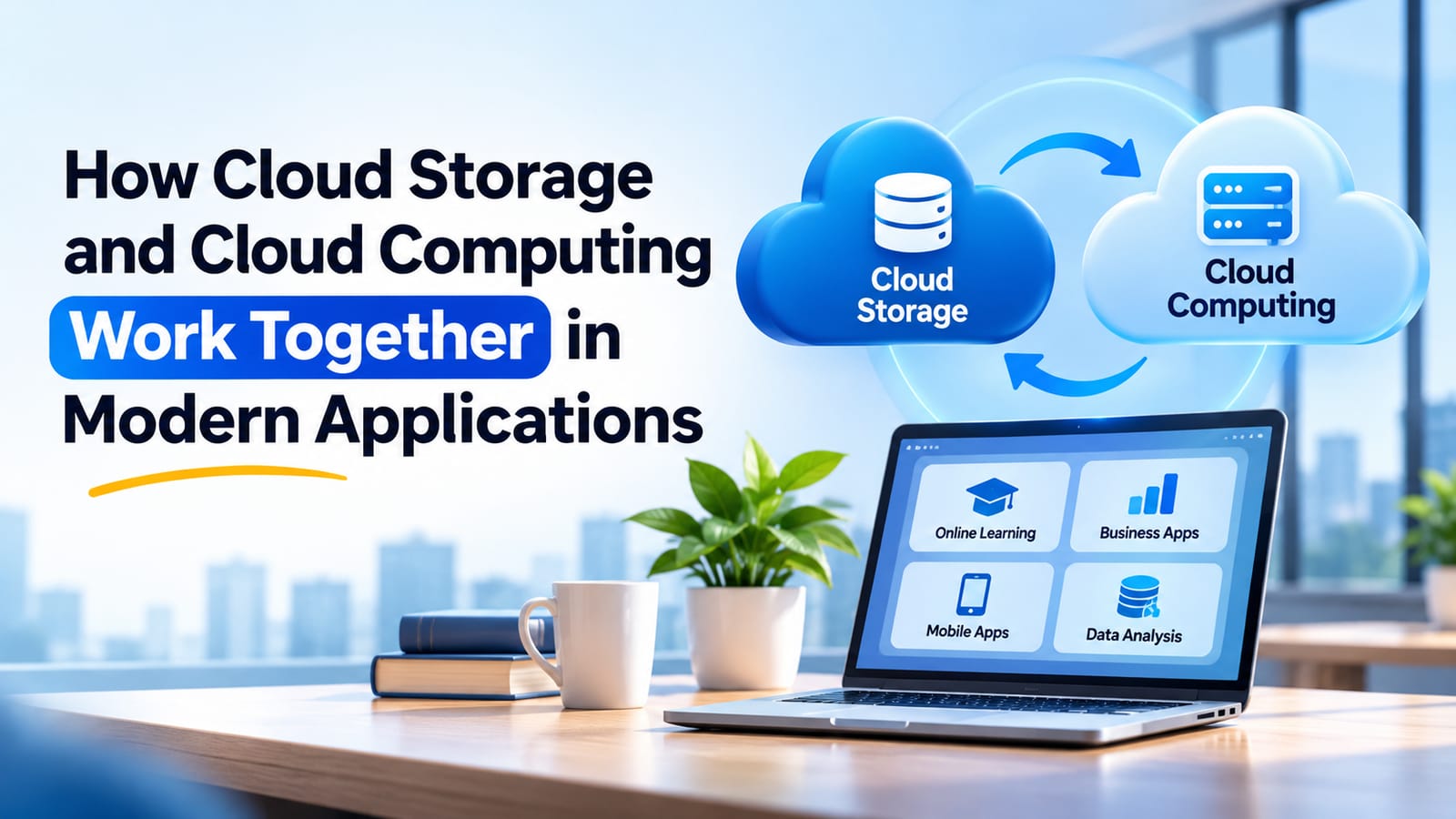
Although these terms are often used together, they serve different purposes. Cloud storage provides a place to keep digital information, while cloud computing provides the processing power and resources needed to work with that information. When combined, they help applications operate efficiently, support collaboration, and handle growing amounts of data.
What Is Cloud Storage?
Cloud storage is a service that allows users and organisations to save digital files on remote servers instead of depending entirely on a computer's local storage.
These files can include documents, images, videos, databases, backups, and application data. Users can access their stored information through an internet connection and the appropriate permissions.
For example, when someone uploads a document to an online storage platform, the file is stored on remote infrastructure. The user can then access it from another device without carrying the original computer.
Common uses of cloud storage include:
Saving and sharing documents across devices.
Storing photographs, videos, and other media.
Maintaining backups of important business information.
Supporting websites and mobile applications.
Keeping project files accessible to distributed teams.
Cloud storage is useful because it offers flexible capacity and remote access. However, organisations still need to consider access permissions, encryption, backup policies, and data protection.
What Is Cloud Computing?
Cloud computing refers to the delivery of computing resources through the internet. Instead of purchasing and maintaining every server or computing system locally, organisations can access resources from cloud service providers.
These resources may include virtual servers, databases, networking, application hosting, development environments, and processing capacity.
For example, an online shopping application needs computing resources to display products, process customer requests, manage orders, and communicate with its database. Cloud computing can provide the infrastructure required to perform these tasks.
Cloud computing commonly supports:
Hosting websites and applications.
Running software and business platforms.
Processing large amounts of data.
Developing and testing applications.
Supporting artificial intelligence and analytics workloads.
The resources can often be adjusted according to application requirements. This helps organisations respond to changes in usage without building all infrastructure themselves.
Cloud Storage vs Cloud Computing: What Is the Difference?
Cloud storage and cloud computing are connected, but they are not the same service.
Cloud storage focuses on saving and retrieving data. Cloud computing focuses on processing data and running applications.
Consider a simple example: a photo-editing application.
The images uploaded by a user may be saved in cloud storage. The application may use cloud computing resources to resize images, apply filters, generate previews, and process editing requests.
In this situation, storage keeps the files available, while computing performs the work required by the application.
Both services can operate independently, but modern applications often combine them to deliver a complete digital experience.
How Do Cloud Storage and Cloud Computing Work Together?
A modern application may use several cloud services at the same time. The general process can be understood through a few steps.
1. Users Upload or Create Data
A user interacts with an application and uploads a document, image, video, or other information. The application receives the data through its interface.
2. Cloud Storage Saves the Information
The application sends the data to a storage service. The service stores the information and makes it available according to the application's access rules.
3. Cloud Computing Processes the Data
When the application needs to work with the stored information, computing resources perform the required operations. These may include calculations, file conversion, image processing, or data analysis.
4. The Application Returns the Result
After processing, the application displays the result to the user. Depending on the application, the updated information may also be saved back to cloud storage.
This combination allows applications to manage information and perform tasks without relying only on the user's device.
Real-World Applications of Cloud Storage and Computing
Cloud storage and computing support many digital services used by individuals, educational institutions, and businesses.
Online Learning Platforms
Learning platforms store course materials, assignments, recorded sessions, and student resources. Computing services help deliver lessons, manage user activity, and support assessments.
Cloud-based education systems can make learning resources accessible from different locations and devices. Read more about cloud computing in modern education.
Business Applications
Business applications use cloud infrastructure to manage customer information, documents, transactions, and internal workflows. Computing resources help process requests and keep applications available to users.
Media and Entertainment
Streaming and media platforms store large collections of digital content. Computing resources support content delivery, recommendations, video processing, and other application functions.
Data Analysis
Organisations collect information from websites, applications, devices, and business systems. Cloud storage keeps the data, while cloud computing resources help process and analyse it.
Mobile Applications
Mobile applications often store user preferences, files, and account information remotely. Cloud computing services support authentication, notifications, application logic, and other background operations.
Key Benefits of Combining Cloud Storage and Cloud Computing
Using both services together can provide several practical advantages.
Flexible capacity: Organisations can increase storage or computing resources as their requirements change.
Remote accessibility: Authorised users can access applications and information from different locations.
Application performance: Computing resources can process requests without depending entirely on a user's local device.
Centralised information: Teams can work with shared data instead of maintaining multiple disconnected copies.
Support for innovation: Developers can build applications that use databases, analytics, automation, and artificial intelligence services.
These benefits depend on the architecture, provider, configuration, security controls, and cost management practices used by an organisation.
Security Considerations for Cloud-Based Applications
Moving information and applications to the cloud does not remove the need for security. Organisations must protect both stored information and the systems that process it.
Important practices include:
Use strong authentication and role-based access controls.
Encrypt sensitive information during transfer and storage.
Review permissions regularly.
Maintain reliable backup and recovery procedures.
Monitor application activity and unusual access.
Understand the security responsibilities shared with the cloud provider.
A well-planned cloud environment should consider security from the beginning rather than treating it as a final step.
Skills Students Can Develop in Cloud Computing
Understanding cloud storage and computing introduces students to several important areas of technology. These include networking, operating systems, databases, programming, cloud platforms, security, and application deployment.
Practical learning can also help students understand how applications are hosted, how data moves between services, and how computing resources are managed.
Students exploring this field can learn more about the skills required for BCA Cloud Computing graduates. They can also explore the benefits of cloud computing for students and how cloud computing supports education.
Is Cloud Computing a Useful Field to Study?
Cloud technology is used across software development, education, finance, healthcare, retail, media, and many other industries. Understanding how cloud infrastructure works can provide a useful foundation for students interested in technology careers.
A BCA Cloud Computing programme can introduce learners to computing fundamentals and related areas such as programming, databases, networking, and cloud technologies. The subjects and practical exposure depend on the programme curriculum.
Students interested in this academic path can explore the BCA Cloud Computing programme at MH Cognition to understand its course information and learning details.
Conclusion
Cloud storage and cloud computing perform different but connected roles in modern applications. Storage keeps information available, while computing resources process that information and run the applications people use every day.
Together, they support online learning, business software, mobile applications, media services, and data analysis. Understanding how these technologies work together is a useful starting point for anyone interested in cloud infrastructure and modern software development.