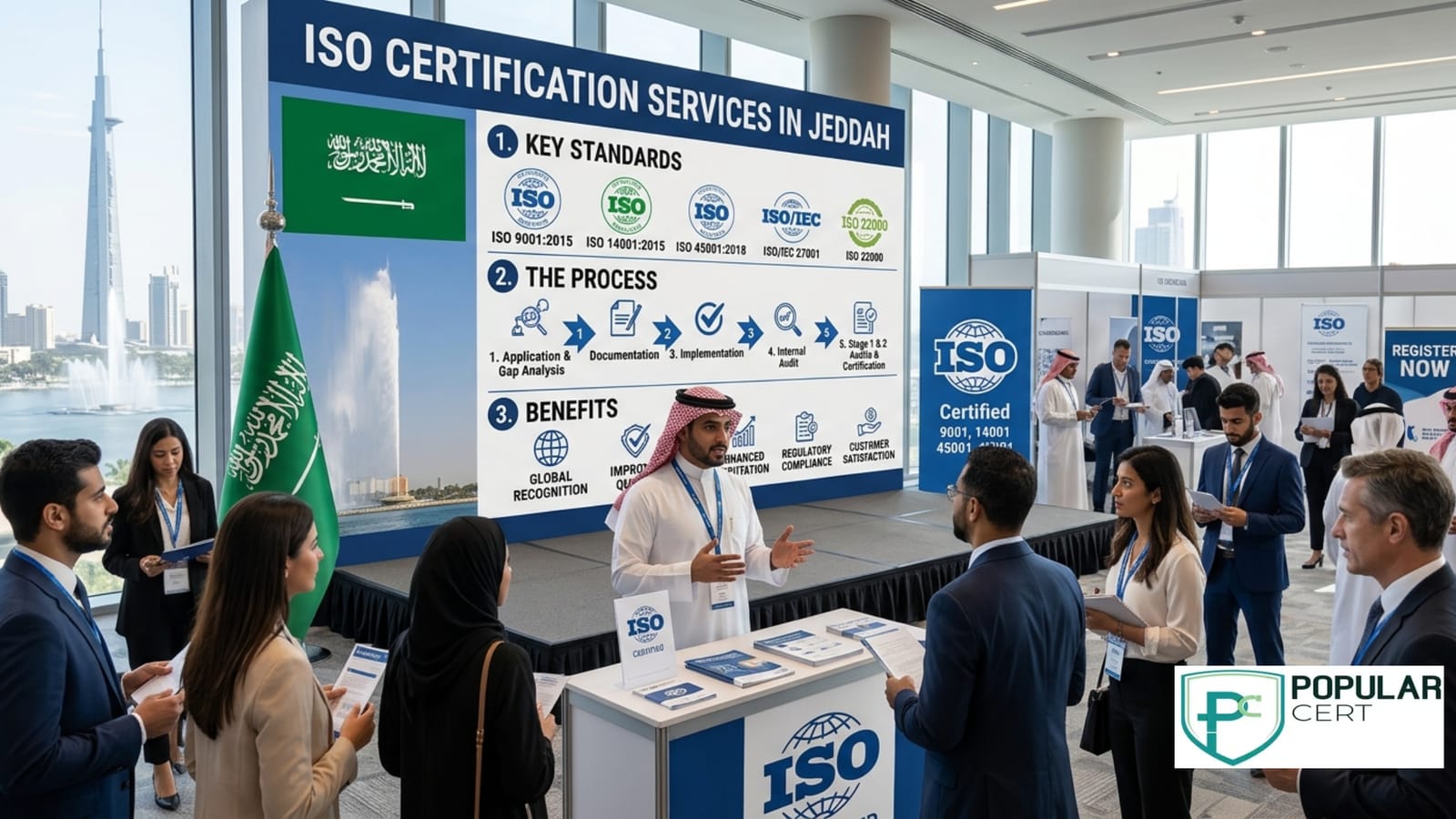
Jeddah is an important commercial and industrial centre in Saudi Arabia, with businesses operating across manufacturing, logistics, construction, healthcare, food processing, trading, and other sectors. As customer expectations and quality requirements continue to develop, organizations need reliable systems to manage their operations and demonstrate their commitment to consistent performance.
ISO certification services in Jeddah help businesses establish management systems based on internationally recognized standards. These systems can improve quality management, workplace safety, environmental performance, information security, and food safety.
Whether a company wants to improve its internal processes, meet customer requirements, or prepare for business opportunities, selecting the right ISO standard is an important first step.
This guide explains the major ISO standards relevant to Jeddah businesses, the certification process, key benefits, and how to choose suitable certification support.
What Are ISO Certification Services?
ISO certification services help organizations understand, implement, and obtain independent certification against applicable ISO management system standards.
The process generally involves identifying the relevant standard, assessing existing practices, developing required procedures, implementing the management system, and completing an external certification audit.
ISO does not directly certify companies. Independent certification bodies conduct audits and decide whether an organization meets the requirements of the selected standard.
Businesses may work with an ISO consultant to prepare their systems before approaching a certification body for the independent assessment.
Why Do Businesses in Jeddah Need ISO Certification?
Businesses in Jeddah operate in competitive local and international markets. Many customers, suppliers, contractors, and project owners expect organizations to demonstrate consistent processes and effective management practices.
ISO certification can help businesses establish a structured approach to meeting these expectations.
Key reasons organizations consider ISO certification include:
Customer confidence: Demonstrates that the organization follows an independently assessed management system.
Process improvement: Helps standardize procedures and responsibilities.
Tender readiness: Can support eligibility where customers or tender documents specify particular ISO requirements.
Risk management: Helps identify and manage operational, environmental, safety, and information security risks.
Employee awareness: Establishes clearer responsibilities and encourages consistent practices.
Business development: Can strengthen an organization's profile when working with customers and partners.
Continual improvement: Encourages regular monitoring, audits, corrective actions, and management reviews.
Certification does not automatically guarantee contracts, regulatory approval, or business growth. Its value depends on the organization's actual implementation and the requirements of its customers and industry.
Major ISO Standards for Businesses in Jeddah
The appropriate ISO standard depends on the organization's activities, risks, customer expectations, and business objectives.
The following standards are relevant to many organizations operating in Jeddah.
ISO standard
Full name
Suitable industries
ISO 9001
Quality Management System
Manufacturing, construction, trading, logistics, and services
ISO 14001
Environmental Management System
Construction, manufacturing, oil and gas, and industrial operations
ISO 45001
Occupational Health and Safety Management System
Construction, manufacturing, logistics, and facilities management
ISO 22000
Food Safety Management System
Food processing, catering, restaurants, and food supply chains
ISO 27001
Information Security Management System
IT companies, financial services, healthcare, and technology
ISO 13485
Medical Devices Quality Management System
Medical device manufacturers and related suppliers
ISO 50001
Energy Management System
Manufacturing, commercial facilities, and energy-intensive operations
ISO 22301
Business Continuity Management System
Financial services, IT, logistics, and essential service providers
1. ISO 9001 Certification in Jeddah
ISO 9001 is one of the most widely used quality management standards. It helps organizations establish processes for delivering products and services that consistently meet customer and applicable requirements.
Businesses can use ISO 9001 to improve process control, customer satisfaction, supplier management, performance monitoring, and corrective action.
It is suitable for manufacturing companies, contractors, trading businesses, logistics providers, and service organizations.
2. ISO 14001 Certification in Jeddah
ISO 14001 provides a framework for managing environmental responsibilities and improving environmental performance.
Organizations can use it to identify environmental aspects, control waste, monitor resource consumption, prevent pollution, and manage applicable environmental obligations.
It is particularly relevant to construction, manufacturing, industrial facilities, and logistics operations.
3. ISO 45001 Certification in Jeddah
ISO 45001 focuses on occupational health and safety management.
It helps organizations identify workplace hazards, assess safety risks, establish operational controls, and improve employee safety.
Construction companies, factories, warehouses, transport businesses, and maintenance contractors can benefit from implementing this standard.
4. ISO 22000 Certification in Jeddah
ISO 22000 establishes requirements for a Food Safety Management System.
It helps food businesses identify food safety hazards, implement preventive controls, manage supplier requirements, and maintain food safety throughout relevant operations.
It is suitable for food manufacturers, processors, catering companies, restaurants, and other food-chain organizations.
5. ISO 27001 Certification in Jeddah
ISO 27001 helps organizations establish an Information Security Management System to protect information and manage information security risks.
It is relevant to IT companies, software providers, financial organizations, healthcare facilities, and businesses that handle sensitive customer or business information.
6. ISO 13485 Certification in Jeddah
ISO 13485 is a quality management system standard specifically designed for organizations involved in medical devices.
It supports quality and regulatory requirements across relevant medical device activities, including design, production, storage, distribution, and related services.
ISO Certification Process in Jeddah
Obtaining ISO certification requires more than preparing documents. The organization must implement the management system and demonstrate that it works effectively.
The following steps explain the general process.
Step 1: Identify the Suitable ISO Standard
First, understand the organization's activities and determine which ISO standard matches its business requirements.
For example:
A manufacturing company may need ISO 9001.
A construction contractor may consider ISO 9001 and ISO 45001.
A food processing company may consider ISO 22000.
An IT service provider may consider ISO 27001.
An industrial facility may consider ISO 14001 and ISO 50001.
Some organizations may need more than one standard, depending on their operations and customer requirements.
Step 2: Conduct a Gap Assessment
A gap assessment compares existing business practices with the requirements of the selected ISO standard.
It helps identify missing procedures, unclear responsibilities, incomplete records, and areas requiring improvement.
The findings are used to prepare an implementation plan.
Step 3: Prepare the Required Documentation
The organization develops the documents and records needed to operate its management system.
Depending on the selected standard, these may include:
Management system scope
Policies and objectives
Procedures and work instructions
Risk and opportunity assessments
Operational control records
Training and competence records
Monitoring and measurement records
Internal audit reports
Management review records
Corrective action records
Documentation should reflect actual business operations rather than being prepared only for the certification audit.
Step 4: Implement the Management System
After preparing the required procedures, the organization puts them into practice.
Employees should understand their responsibilities, follow relevant processes, and maintain the required records.
Management should provide the necessary resources and monitor implementation progress.
Step 5: Conduct Employee Training and Awareness
Employees play an important role in the effectiveness of an ISO management system.
Training should explain the relevant policies, procedures, responsibilities, and operational controls.
For example, ISO 45001 awareness may cover workplace hazards and safety responsibilities, while ISO 27001 awareness may address information security risks and access controls.
Step 6: Conduct an Internal Audit
An internal audit evaluates whether the management system meets the applicable ISO requirements and the organization's own procedures.
It helps identify nonconformities and areas that need corrective action before the external certification audit.
Step 7: Complete the Management Review
Top management reviews the performance and suitability of the management system.
The review may consider audit results, customer feedback, objectives, performance indicators, nonconformities, corrective actions, and improvement opportunities.
Step 8: Complete the External Certification Audit
The organization selects an independent certification body to conduct the certification assessment.
The process generally includes:
Stage 1 Audit: Reviews the management system documentation, scope, and readiness for the main assessment.
Stage 2 Audit: Evaluates whether the management system has been effectively implemented and meets the applicable standard requirements.
If nonconformities are identified, the organization must address them through corrective actions. The certification body reviews the findings and makes the certification decision.
Documents Required for ISO Certification
The exact documents depend on the selected standard, business activities, and management system scope.
The following are common examples:
Document
Purpose
Management system policy
Defines the organization's commitments
Scope of the management system
Identifies covered activities and locations
Objectives and action plans
Establishes measurable improvement targets
Risk assessment
Identifies relevant risks and opportunities
Procedures and work instructions
Explains how activities are controlled
Training records
Demonstrates employee competence and awareness
Operational records
Provides evidence of implementation
Internal audit report
Records management system audit results
Management review minutes
Documents management evaluation
Corrective action records
Tracks the resolution of identified issues
Not every organization needs identical documents. The documentation should be appropriate to the standard and the organization's operations.
How Long Does ISO Certification Take in Jeddah?
The time required depends on several factors, including the organization's size, number of locations, operational complexity, existing management practices, and selected ISO standard.
A business with established procedures may need less preparation than an organization developing a management system for the first time.
The general stages include:
Initial assessment and planning
Documentation and system development
Implementation and employee training
Internal audit and management review
External certification audit
Corrective actions, if required, and certification decision
Organizations should avoid choosing a provider based only on promises of immediate certification. Effective implementation and a proper independent audit are essential.
Benefits of ISO Certification for Jeddah Businesses
ISO certification can provide operational and commercial benefits when the management system is properly implemented.
Improved Operational Efficiency
Standardized procedures help employees understand how tasks should be performed. This can reduce process inconsistencies and improve coordination between departments.
Better Customer Satisfaction
Quality management practices help organizations monitor customer requirements, handle complaints, and identify opportunities to improve products and services.
Stronger Risk Management
ISO management systems encourage organizations to identify risks and establish suitable controls before problems affect business operations.
Improved Workplace Safety
ISO 45001 supports systematic hazard identification, risk assessment, employee participation, and workplace safety controls.
Better Environmental Performance
ISO 14001 helps businesses monitor environmental impacts and improve their approach to waste, energy, water, and pollution prevention.
Greater Business Credibility
An independently issued certificate can provide customers and business partners with evidence that the organization has been assessed against a recognized management system standard.
Support for Supplier and Tender Requirements
Some customers, contractors, and procurement processes specify particular ISO certifications. Having the relevant certificate may help an organization meet those stated requirements, subject to the tender or contract conditions.
How to Choose an ISO Certification Company in Jeddah
Selecting the right certification support is important because the provider's role can affect the quality and credibility of the process.
Before choosing a provider, consider the following factors:
1. Understand Whether You Need a Consultant or Certification Body
An ISO consultant helps an organization understand the standard, develop its management system, and prepare for the audit.
A certification body independently audits the system and makes the certification decision.
These are different responsibilities. A consultant should not present its implementation support as the independent certification decision.
2. Check Accreditation and Certification Scope
If accreditation is important to your customers or contracts, verify that the certification body's accreditation is valid and covers the relevant management system standard and sector.
In Saudi Arabia, the Saudi Accreditation Center (SAAC) is the national accreditation body. It provides accreditation services for management system certification bodies, among other conformity assessment organizations.
Check the certification body's current accreditation status, applicable scope, and recognition arrangements before proceeding.
3. Review Industry Experience
Choose a provider or consultant familiar with your business sector.
For example, the implementation needs of a food manufacturer will differ from those of a construction contractor or IT company.
4. Understand the Implementation Approach
A suitable provider should explain the assessment, documentation, training, implementation, internal audit, and certification preparation stages.
Be cautious of offers that focus only on issuing a certificate without explaining the required management system implementation and independent audit.
5. Clarify the Scope, Costs, and Responsibilities
Request a clear explanation of the services included, audit arrangements, applicable fees, expected responsibilities, and any additional costs.
This helps avoid misunderstandings during implementation.
How PopularCert Supports ISO Certification in Jeddah
PopularCert helps organizations understand ISO requirements and prepare management systems that suit their business activities.
Our support can include:
ISO standard selection: Helping identify the standard relevant to the organization's industry and objectives.
Gap assessment: Reviewing current practices and identifying areas that need improvement.
Documentation support: Helping prepare policies, procedures, registers, and management system records.
Employee training: Supporting awareness of ISO requirements and individual responsibilities.
Implementation guidance: Helping organizations put documented procedures into practice.
Internal audit preparation: Supporting the review of management system effectiveness and identification of nonconformities.
Management review support: Helping management evaluate system performance and improvement opportunities.
Certification audit readiness: Preparing the organization for assessment by an independent certification body.
We support businesses in building practical management systems rather than focusing only on documentation. The final certification decision remains with the independent certification body.
Conclusion
ISO certification services in Jeddah can help businesses improve operational processes, manage risks, strengthen customer confidence, and demonstrate their commitment to recognized management system requirements.
The right standard depends on the organization's industry and objectives. Whether a business needs ISO 9001, ISO 14001, ISO 45001, ISO 22000, or ISO 27001, successful certification requires proper planning, implementation, internal evaluation, and an independent external audit.
By selecting suitable implementation support and verifying the certification body's credentials, organizations in Jeddah can establish management systems that support long-term business improvement.
Frequently Asked Questions
1. Which ISO certification is best for businesses in Jeddah?
The best standard depends on the organization's activities. ISO 9001 is suitable for quality management, ISO 14001 for environmental management, ISO 45001 for occupational health and safety, ISO 22000 for food safety, and ISO 27001 for information security.
2. Is ISO certification mandatory in Jeddah?
ISO certification is generally voluntary. However, specific customers, contracts, tenders, or sector requirements may request particular certifications. Businesses must also meet applicable Saudi laws and regulatory requirements separately.
3. How long does it take to obtain ISO certification?
The timeframe depends on the organization's size, complexity, selected standard, and readiness. It includes implementation, internal evaluation, and the external certification audit.
4. Can a small business in Jeddah obtain ISO certification?
Yes. ISO management system standards can be applied to organizations of different sizes. The system should be designed according to the company's activities, risks, and operational requirements.
5. How can I verify an ISO certification body in Saudi Arabia?
Check the certification body's current accreditation status, the relevant management system standard in its accreditation scope, and any applicable recognition requirements. The Saudi Accreditation Center provides information about accreditation services and certification bodies.