An exploration of touch, perception, and the invisible distance between everything we believe we touch.
You reach out and touch a wall. You feel its roughness, its temperature, perhaps the faint unevenness beneath your fingertips. It feels like the simplest, most unquestionable experience in the world. You are here, the wall is there, and for a brief moment, the two meet.
But what if they never actually do?
What if, despite everything you have ever touched, held, hugged or felt, you have never truly made contact with anything?
It sounds absurd. After all, how could we possibly question something as fundamental as touch? We use it to understand the world before we even learn to speak. A child's first instinct is to reach out, to hold, to feel. Touch reassures us that something exists beyond ourselves.
Yet, hidden beneath this familiar experience is a rather extraordinary scientific reality.
The Illusion of Contact
Everything around us is made of atoms. The table you are sitting at, the phone in your hand, the skin covering your fingers, even the air passing through your lungs. Atoms themselves are made up of a tiny nucleus surrounded by electrons.
Here is where things become interesting.
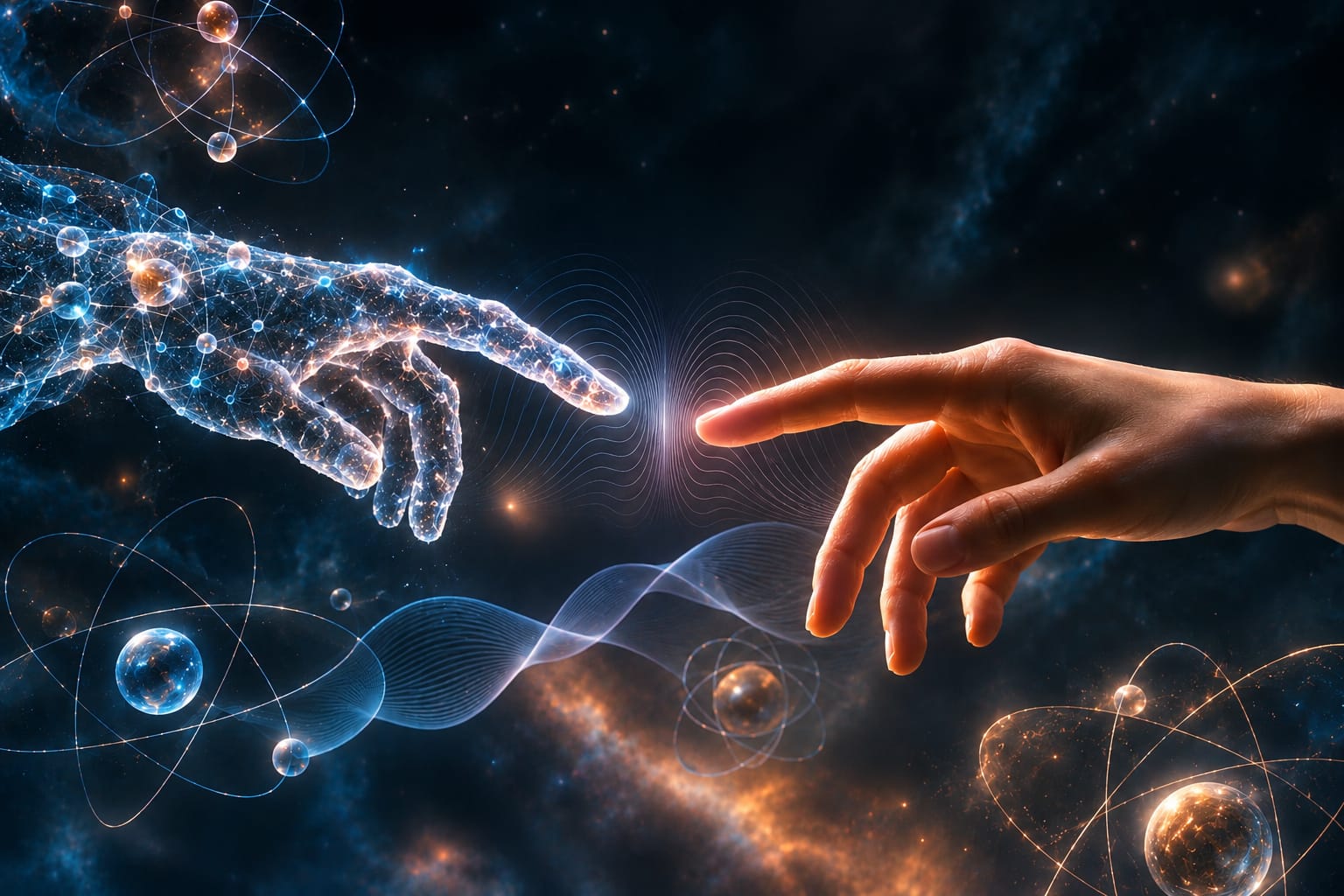
When you press your finger against a surface, the atoms in your finger approach the atoms in that surface. However, their electron clouds interact through electromagnetic forces. The electrons resist being pushed into the same quantum states, an effect related to the Pauli exclusion principle.
In other words, what you experience as the wall pushing back against your finger is largely the result of electromagnetic interactions and quantum mechanics.
There is no tiny moment in which two solid atomic surfaces simply merge together.
The sensation of contact is real, but the explanation behind it is very different from what our intuition suggests.
Then what exactly are we feeling?
Our skin contains specialised sensory receptors that respond to pressure, vibration, temperature and other physical changes. When you touch an object, these receptors generate electrical signals that travel through your nervous system to your brain.
Your brain interprets these signals and creates the experience we call touch.
Think about it.
You do not experience the wall directly in the way you might imagine. You experience the information your nervous system receives about the wall.
The same applies to everything else. The warmth of sunlight, the softness of a blanket, the coldness of metal and the familiar feeling of someone's hand resting on yours.
Your brain constructs your experience of all of it.
The World We Experience Is Not the World We Receive
This raises a much bigger question: how much of what we experience is actually out there, and how much is created by our minds?
Consider colour.
The sky does not contain blue in the way a container holds water. Objects reflect certain wavelengths of light, and our visual system interprets them as colour. The experience of blue happens through the interaction between the physical world and our brains.
Sound works similarly. Vibrations travel through the air, but the experience of hearing a song, recognising a familiar voice or feeling disturbed by a particular noise happens within our nervous system.
We spend our lives believing that we experience the world exactly as it is. Yet, our senses are not transparent windows into reality. They are biological systems that interpret information.
And perhaps that is the strangest part: the world we know is always experienced through the mind we use to understand it.
Does That Make Our Experiences Less Real?
Not at all.
It is tempting to conclude that if touch is mediated by forces, receptors and electrical signals, then physical contact is somehow an illusion.
But that would be misunderstanding the science.
You really do touch the wall. You really do feel the warmth of another person's hand. The forces involved are physical, measurable and responsible for the sensations you experience.
The surprising part is not that touch is unreal. It is that reality is much more complicated than our everyday descriptions of it.
Perhaps the more interesting question is not whether we have ever touched anything, but whether we have ever experienced anything without our minds interpreting it first.
The Distance Between Us
Think about the last time you held someone's hand.
You probably weren't thinking about electrons, electromagnetic forces or sensory receptors. You were simply experiencing a moment of connection.
And that experience mattered.
Science can explain the physical interactions that make touch possible. It can describe how pressure becomes a nerve impulse and how the brain processes that information. But describing the mechanism does not necessarily capture the personal meaning of the experience.
A hand held in reassurance feels different from a hand held in farewell, even if the physical process is remarkably similar.
Perhaps this is where science and philosophy meet.
We may never experience the world without the filter of our senses, but that does not make the world meaningless. If anything, it makes our experience of it more fascinating.
So, the next time you reach out to touch something, pause for a moment.
You are interacting with a universe of invisible forces, quantum rules and biological interpretations, all of which combine to create something as ordinary as the feeling of a fingertip against a surface.
Maybe you have never touched anything in quite the way you imagined. But you have experienced something real. And perhaps that is even more extraordinary.