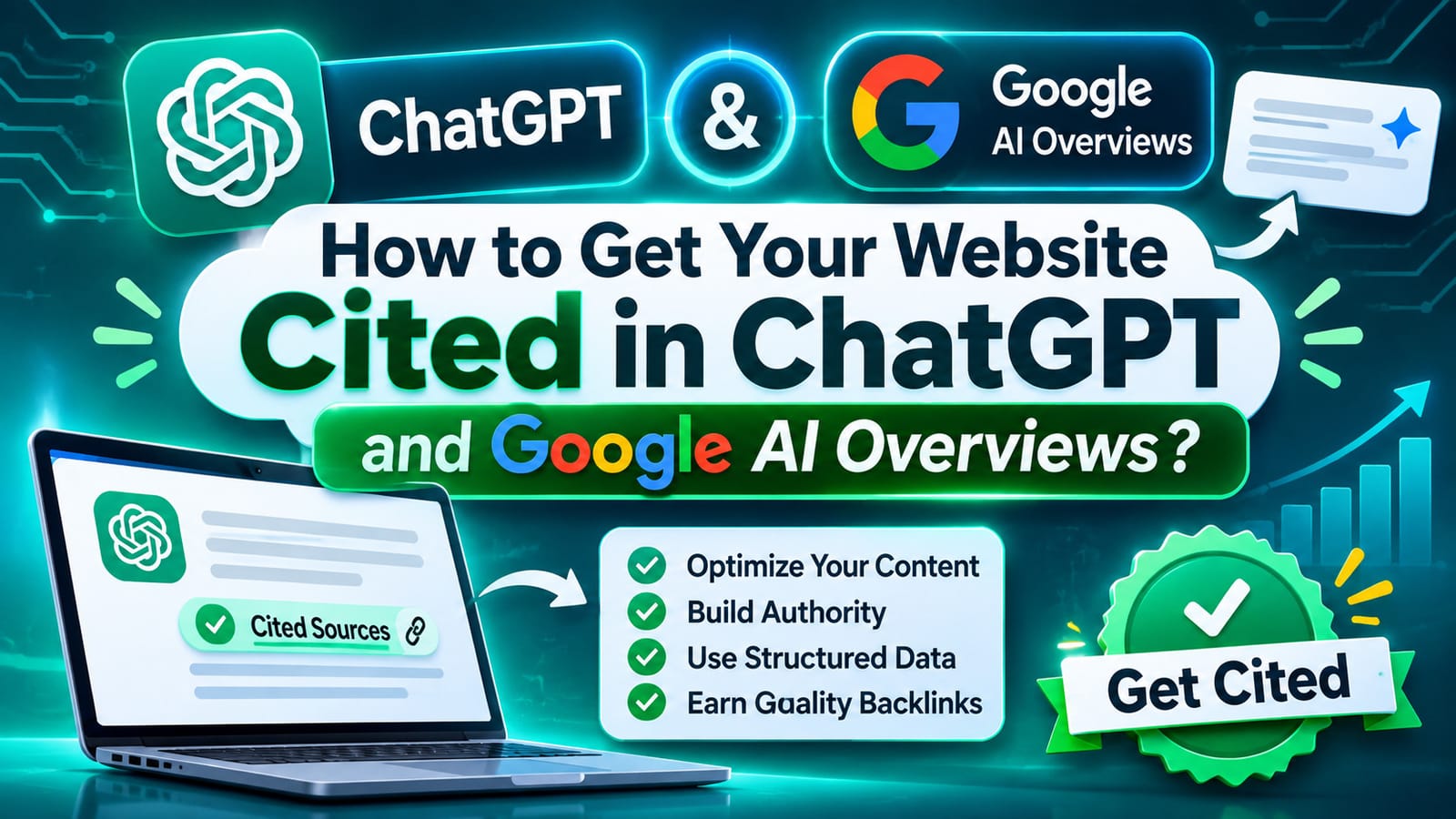
Search is changing. People no longer rely only on traditional search results to find information. They increasingly ask questions directly through tools such as ChatGPT and Google Search’s AI Overviews, expecting clear answers, useful recommendations, and trustworthy sources.
For website owners, this shift creates a new challenge: getting discovered is no longer just about appearing in a list of blue links. Businesses also want their content to be referenced, linked, or cited when AI systems answer relevant questions.
However, there is no guaranteed shortcut to getting cited by ChatGPT or Google AI Overviews. Both systems use different methods to discover and select information. The strongest approach is to create genuinely helpful content, maintain a technically accessible website, and establish clear signals of expertise and trust.
Here are practical ways to improve your chances of being discovered and cited in AI-powered search.
1. Understand How AI Search Finds Information
Before optimizing a website, it is important to understand how AI-powered search works.
Google AI Overviews use information from Google's Search systems to generate summaries and provide links to relevant websites. ChatGPT Search can also retrieve information from the web and include links to sources that help support its responses.
These experiences are not identical, but they share an important principle: useful, relevant information matters.
Understanding the technology behind these systems can make optimization decisions easier. For a basic introduction, this guide explains how AI works and how modern AI systems process information.
Website owners should remember that being indexed or accessible does not guarantee inclusion in an AI-generated answer. The goal should be to make every important page useful, understandable, trustworthy, and easy to discover.
2. Create Helpful Content That Answers Real Questions
One of the most effective ways to improve AI search visibility is to publish content that directly addresses the questions your audience is asking.
Instead of creating articles only to target broad keywords, focus on the problems people want to solve.
For example, a digital marketing agency could publish content answering questions such as:
How can a small business improve its online visibility?
What is the difference between SEO and GEO?
How can businesses optimize content for AI search?
Why is a website not appearing in Google search results?
Each article should provide a meaningful answer rather than repeating general information available everywhere.
Include practical explanations, examples, relevant recommendations, and original insights. If you have experience with a particular strategy, explain what worked, what did not, and why.
Google's guidance emphasizes helpful, original, people-first content rather than material created mainly to manipulate search rankings. This principle is equally valuable when preparing content for AI discovery.
3. Structure Your Content for Easy Understanding
Clear content structure helps readers find information quickly. It also makes individual sections easier to interpret.
Use descriptive headings to organize your articles into logical sections. Each heading should accurately explain what the following section covers.
A useful structure might include:
A direct introduction to the topic.
A short explanation of the main question.
Detailed sections covering important points.
Examples, statistics, or practical steps.
A conclusion with actionable advice.
Frequently asked questions where they genuinely help readers.
Keep paragraphs focused. Avoid putting several unrelated ideas into one long block of text.
You can also answer important questions directly near the beginning of a section, then provide supporting explanations underneath. This makes the content easier to scan without reducing its depth.
4. Build Credibility with Accurate and Reliable Information
AI systems need relevant information, but website owners should also care about whether readers can trust what they publish.
Content credibility comes from accuracy, transparency, and useful evidence. Whenever you include statistics, research findings, or industry claims, link to the original source where possible.
For stronger credibility:
Identify the author and provide a relevant professional biography.
Reference reliable studies, official documentation, and recognized industry sources.
Update outdated information when facts or recommendations change.
Correct inaccurate statements instead of allowing them to remain published.
Clearly distinguish personal opinions from verified facts.
It also helps to explain how a recommendation works instead of simply telling readers that it is effective.
For example, an article about artificial intelligence should explain the technology accurately. Readers looking for background information can explore this introduction to artificial intelligence.
Credibility is not created by adding a large number of external links. It comes from making claims that readers can understand, evaluate, and verify.
5. Make Your Website Accessible to Search Crawlers
Even excellent content can struggle to gain visibility if search engines cannot access or understand it.
Technical SEO remains an important part of AI search optimization. Google explains that pages must meet its normal Search eligibility requirements to be considered for supporting links in AI Overviews and AI Mode.
Review these important technical areas:
Check robots.txt: Make sure important website sections are not accidentally blocked from search crawlers.
Review indexing: Use Google Search Console to identify indexing problems and understand whether important pages are available in Google Search.
Check page accessibility: Ensure that your main content can be accessed without unnecessary technical barriers.
Improve mobile usability: Pages should work properly on smartphones, tablets, and desktop screens.
Use internal links: Connect related articles and important pages so readers and crawlers can discover useful information.
For ChatGPT Search specifically, OpenAI advises website owners to allow its OAI-SearchBot crawler if they want their content to be discoverable for ChatGPT search results. Review your robots.txt configuration and hosting settings to ensure that the relevant crawler is not unintentionally blocked.
6. Use Structured Data Correctly
Structured data helps search engines understand specific information on a webpage. Depending on the page, this may include details about an organization, product, article, or other supported content type.
For example, Article structured data can identify an article's headline, author, and publication information.
However, structured data should accurately represent the visible content on the page. Adding irrelevant or misleading markup can create problems rather than improve visibility.
It is also important to understand that schema markup does not guarantee an AI citation. Google has stated that there is no special AI schema or additional markup required to appear in AI Overviews or AI Mode.
Use structured data where it is appropriate, follow the relevant guidelines, and prioritize the quality of the actual page.
7. Build Topic Authority through Related Content
Publishing one article about a subject is rarely enough to demonstrate meaningful expertise.
A better approach is to build a connected collection of useful resources around your main topics. This is often called topical authority.
For example, a website covering AI and digital marketing could publish separate guides about:
Artificial intelligence and its applications.
Generative AI and large language models.
Search engine optimization fundamentals.
Generative Engine Optimization (GEO).
Answer Engine Optimization (AEO).
AI-powered content discovery.
Connect these resources through relevant internal links. This helps readers explore a subject in greater depth and gives search engines additional context about the relationship between your pages.
For readers who want to understand the differences between major AI technologies, a detailed guide to AI vs machine learning can provide useful background.
The key is relevance. Every article should offer standalone value rather than exist simply to increase the number of pages on your website.
8. Strengthen Your Brand's Online Presence
AI search visibility is not only about individual website pages. A recognizable brand with consistent, accurate information across relevant platforms can make it easier for people to identify and evaluate a business.
Start by keeping your business name, website, services, and contact details consistent across your official profiles.
You can also strengthen your presence by:
Publishing useful industry insights on professional platforms.
Participating in relevant industry discussions.
Earning genuine mentions from reputable websites.
Sharing original research, case studies, and practical resources.
Maintaining accurate business information across online directories.
Avoid purchasing artificial mentions or creating low-quality links just to influence AI systems. Genuine recognition and useful contributions provide a stronger long-term foundation.
9. Measure Your Progress and Improve Your Content
AI search optimization should be treated as an ongoing process, not a one-time activity.
Monitor your website's performance using tools such as Google Search Console and analytics platforms. Review organic impressions, clicks, indexed pages, engagement, and conversions.
You can also periodically test relevant questions in ChatGPT and Google Search to see whether your brand or content appears as a source. These checks are useful observations, not a complete measurement of AI visibility, because results can vary by query, location, context, and time.
When reviewing your content, ask:
Does the article answer the intended question?
Are the facts accurate and current?
Is the information more useful than a generic summary?
Are the important pages accessible to crawlers?
Do internal links connect related resources?
Are readers taking meaningful actions after visiting?
Use these findings to improve existing pages, fill genuine content gaps, and make your website more useful.
Common Mistakes to Avoid When Optimizing for AI Search
Some website owners try to find shortcuts to AI visibility. Unfortunately, many of these tactics provide little long-term value.
Avoid these common mistakes:
Keyword stuffing: Repeating the same phrase unnaturally makes content difficult to read.
Publishing mass-produced articles: A large quantity of similar pages does not automatically establish expertise or authority.
Inventing statistics: Unsupported numbers and misleading claims can damage credibility.
Ignoring technical SEO: Valuable content still needs to be accessible and eligible for discovery.
Overusing structured data: Markup should describe real page content, not make unsupported claims.
Chasing guaranteed citations: No legitimate strategy can promise that ChatGPT or Google AI Overviews will cite a particular website.
A sustainable approach focuses on readers first and search visibility second.
Conclusion
Getting your website cited in ChatGPT and Google AI Overviews requires more than adding a few keywords or following a new SEO trick. It involves building a website that consistently provides accurate, relevant, accessible, and genuinely useful information.
Start by answering real audience questions, organizing content clearly, supporting claims with reliable sources, and maintaining strong technical SEO. Develop related resources that demonstrate subject knowledge, strengthen your brand presence, and regularly review your website's performance.
AI-powered search will continue to evolve, but the foundation of online visibility remains familiar: publish information people can trust, make it easy to discover, and give readers a reason to choose your website as a valuable resource.
Frequently Asked Questions
How can I get my website cited in ChatGPT?
Publish useful and accurate content, make your pages publicly accessible, and ensure OAI-SearchBot is not blocked if you want to be discoverable through ChatGPT Search. Relevance and selection are not guaranteed.
How do I appear in Google AI Overviews?
Follow Google's established SEO practices. Create helpful content, maintain technical accessibility, provide a good page experience, and make sure important information is available in crawlable text.
Is GEO different from traditional SEO?
GEO focuses on improving a brand's visibility in generative AI experiences, while traditional SEO focuses on visibility in search engines. They overlap significantly because content quality, accessibility, relevance, and credibility matter to both.
Does schema markup guarantee AI citations?
No. Structured data can help search engines interpret page information, but it does not guarantee inclusion in AI-generated answers.
How long does it take to appear in AI search results?
There is no fixed timeline. Discovery and visibility depend on factors such as crawling, indexing, relevance, content quality, and the systems generating each response.