Healthcare in India is continuously evolving, increasing the demand for doctors with strong knowledge of primary healthcare and comprehensive patient management. From treating common illnesses to managing chronic diseases, family medicine plays an important role in improving healthcare accessibility.
This has increased interest in Family Medicine Courses in India, especially among MBBS graduates and practising doctors who want to strengthen their clinical knowledge and explore professional development opportunities.
Family medicine focuses on healthcare for individuals across different age groups. It includes preventive medicine, general medical conditions, chronic disease management, health screening and long-term patient care.
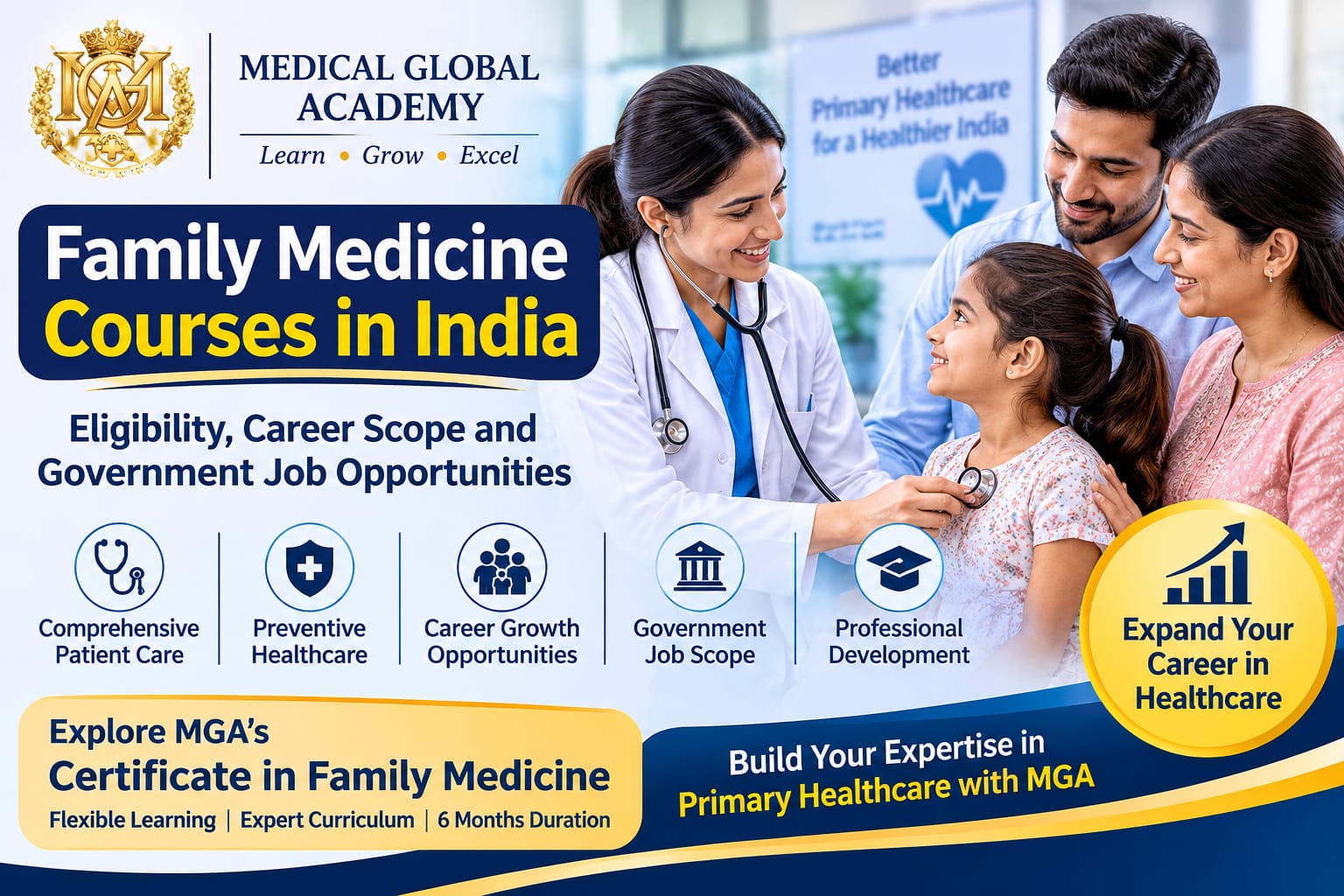
Medical Global Academy (MGA) offers a Certificate in Family Medicine for eligible doctors interested in developing their knowledge of primary healthcare.
1. Why Are Family Medicine Courses in India Becoming Popular?
The growing importance of primary healthcare is one of the major reasons behind the increasing demand for family medicine education.
Some important factors include:
Increasing Chronic Diseases: Diabetes, hypertension, cardiovascular diseases and respiratory disorders require continuous monitoring and management.
Growing Primary Healthcare Needs: Primary Health Centres (PHCs), Community Health Centres (CHCs) and hospitals require doctors with knowledge of common medical conditions.
Preventive Healthcare: Early diagnosis, routine screening and lifestyle counselling are important for reducing disease complications.
Comprehensive Patient Care: Family medicine helps doctors understand different health conditions and provide appropriate initial assessment and patient management.
These developments have increased interest in family medicine courses for MBBS doctors seeking additional clinical knowledge.
2. Types of Family Medicine Courses Available in India
Doctors can explore different educational pathways depending on their qualifications and career objectives.
MD in Family Medicine: A formal postgraduate medical qualification offered through eligible institutions.
DNB Family Medicine: A recognised postgraduate qualification awarded through the National Board of Examinations in Medical Sciences (NBEMS).
NBEMS Diploma in Family Medicine: A formal postgraduate training pathway with prescribed eligibility and examination requirements.
Fellowship in Family Medicine: Speciality-focused professional learning programmes with varying durations and formats.
Certificate Course in Family Medicine: Shorter educational programmes covering primary healthcare and common clinical conditions.
Doctors should understand that certificates, fellowships and recognised postgraduate medical qualifications are different. They are not interchangeable.
3. Family Medicine Course After MBBS: Eligibility
Eligibility depends on the institution and programme.
For professional certificate courses, common requirements may include:
MBBS degree from a recognised medical institution.
Valid NMC or State Medical Council registration.
Relevant clinical experience, where required.
MGA Certificate in Family Medicine
Medical Global Academy lists the following eligibility requirements:
MBBS qualification.
Valid NMC or State Medical Council registration.
Minimum one year of post-qualification clinical experience.
Doctors should verify the latest admission requirements before applying.
4. Certificate in Family Medicine at Medical Global Academy
Medical Global Academy offers a Certificate in Family Medicine designed for eligible doctors who want to strengthen their understanding of primary healthcare.
The programme provides structured learning in different areas of general medical practice.
Programme Highlights:
Duration: 6 months.
Learning format: Online and self-paced.
Curriculum: 24 learning modules.
Eligibility: MBBS with valid medical registration and minimum one year of clinical experience.
Important Learning Areas
The curriculum covers several important medical subjects, including:
General medicine and common clinical conditions.
Cardiovascular health and hypertension.
Diabetes diagnosis and management.
Respiratory medicine.
Paediatric healthcare.
Women's healthcare.
Geriatric medicine.
Dermatology.
Emergency assessment.
Preventive healthcare and lifestyle counselling.
These subjects help doctors develop a broader understanding of patient assessment, common diseases and comprehensive healthcare.
Explore the programme here:
Certificate in Family Medicine – Medical Global Academy
5. Government Job Opportunities After Family Medicine Courses
Government healthcare employment is an important career objective for many MBBS doctors in India.
Doctors may explore opportunities in:
Government Hospitals: Medical Officer positions and general medical services, depending on recruitment eligibility.
Primary Health Centres: Healthcare services involving common illnesses, preventive care and routine patient consultations.
Community Health Centres: General medical services, patient assessment and referral responsibilities.
District Hospitals: Outpatient, inpatient and emergency medical services.
Public Health Programmes: Opportunities involving diabetes screening, hypertension management, maternal healthcare and disease prevention.
Government recruitment depends on the qualifications, registration, experience and selection requirements mentioned in individual vacancy notifications.
6. Can Family Medicine Courses Improve Government Job Chances?
Additional family medicine education can support professional development and strengthen a doctor's understanding of primary healthcare.
It may be beneficial in several ways:
Improved Clinical Knowledge: Doctors can develop a better understanding of common medical conditions, chronic diseases and preventive healthcare.
Professional Development: An additional certificate can demonstrate an interest in continuing medical education.
Primary Healthcare Understanding: Learning about patient assessment, follow-up care and disease prevention can support professional competence.
Relevant Academic Learning: Doctors can add suitable additional education to their professional profiles.
However, completing a certificate course does not guarantee government employment or selection.
For certain Medical Officer positions, MBBS with valid registration may fulfil the prescribed educational requirements. Specialist government positions may require recognised postgraduate qualifications such as MD or DNB.
MGA's Certificate in Family Medicine is a professional skill-development programme, not an equivalent postgraduate specialist qualification.
Doctors should always check the relevant government recruitment notification before applying.
7. Why Choose Medical Global Academy?
Medical Global Academy provides speciality-focused educational programmes for eligible healthcare professionals.
Its Certificate in Family Medicine offers several learning benefits:
Flexible online and self-paced learning.
Structured curriculum covering 24 modules.
Broad coverage of primary healthcare subjects.
Learning focused on common medical conditions.
Additional professional knowledge for eligible MBBS doctors.
Doctors interested in expanding their knowledge of adult medical conditions can also explore MGA's PG Diploma in General Medicine.
Choosing a course should depend on eligibility, curriculum, learning format and individual professional objectives.
8. How to Choose the Best Family Medicine Course in India
Before enrolling in a Family Medicine Course After MBBS, doctors should consider:
Eligibility: Check MBBS, registration and experience requirements.
Curriculum: Review the subjects and clinical learning areas.
Duration: Select a programme that fits your schedule.
Learning Format: Understand whether it is online, hybrid or hospital-based.
Certification: Verify the awarding institution and recognition status.
Career Goals: Check whether the qualification meets your intended employment requirements.
These factors can help doctors make an informed educational decision.
Frequently Asked Questions
1. Which Family Medicine Course is best after MBBS?
Recognised MD and DNB pathways are options for formal postgraduate specialist training. Certificate and fellowship programmes can support additional professional learning.
2. Can I pursue a Family Medicine Course online?
Yes. Several institutions offer online learning options. MGA provides an online, self-paced Certificate in Family Medicine.
3. What is the duration of MGA's Certificate in Family Medicine?
The programme duration listed by MGA is six months.
4. Can a Family Medicine Certificate help me get a government job?
It may support additional clinical learning and professional development, but it does not guarantee government employment or replace recognised postgraduate qualifications required for specialist positions.
5. Is a Family Medicine Certificate equivalent to DNB Family Medicine?
No. DNB is a recognised postgraduate medical qualification, whereas a certificate programme provides additional professional education.
Conclusion
Family medicine is becoming increasingly important in India because of the growing need for accessible primary healthcare, preventive medicine and comprehensive patient management.
For MBBS doctors, exploring Family Medicine Courses in India can provide opportunities to strengthen clinical knowledge and develop a better understanding of general medical practice.
Medical Global Academy's six-month Certificate in Family Medicine offers eligible doctors a flexible learning opportunity covering important areas of primary healthcare.
Doctors interested in government employment should also understand the difference between professional certificates and recognised postgraduate qualifications. Additional education can support professional development, but government recruitment always depends on the prescribed eligibility criteria.
Explore the Certificate in Family Medicine at Medical Global Academy:
https://medicalglobalacademy.com/certificate-in-family-medicine
Disclaimer: MGA's Certificate in Family Medicine is a professional skill-development programme. It is not equivalent to MD, DNB or an NBEMS-recognised postgraduate qualification. Course completion does not guarantee government employment, specialist recognition or recruitment eligibility. Always verify applicable requirements before enrolment or applying for government pos