Walk into almost any garage and look down. Oil stains, tyre marks, a few chips near the door, maybe a patch where something heavy got dragged across it years ago. Concrete is tough, but it isn't invincible, and it's a lot more porous than it looks.
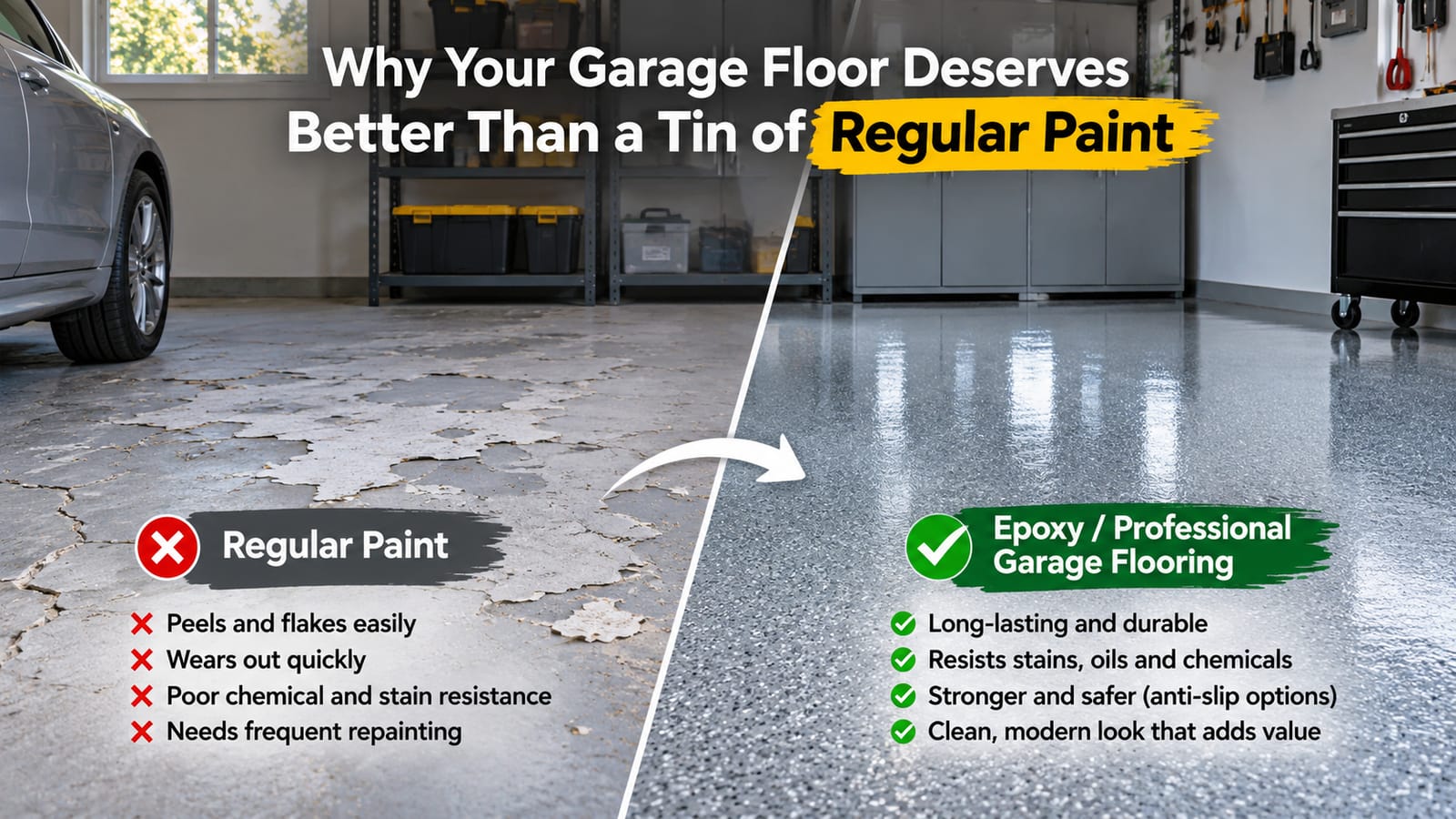
Most people's first instinct is to grab a tin of floor paint from the hardware store and roll it on over a weekend. I get it. It's cheap, it's quick, and for about six months the floor looks brilliant. Then the paint starts lifting where the car tyres sit, and you're back where you started, except now you've got a worse surface to fix.
That's the moment a lot of homeowners start looking into proper epoxy floor painting, and it's worth understanding what you're actually paying for before you commit.
Why ordinary paint gives up so quickly
Standard floor paint sits on top of the concrete like a thin skin. It's fine for a shed floor nobody walks on. It's not fine for a garage.
Hot tyres are the usual culprit. When you park after a drive, the rubber is warm and soft, and it softens the paint underneath it as well. Over time the paint bonds to the tyre instead of the floor. Next time you pull out, a little strip comes with you. Do that a few hundred times and you've got bare patches in exactly two places.
The other problem is that regular paint doesn't really seal anything. Oil, petrol, brake fluid and even a spilled drink can work their way through to the concrete, and once they do, the paint above them starts to bubble.
What epoxy does differently
Epoxy is a two-part system. There's a resin and there's a hardener, and the moment you mix them a chemical reaction starts. That reaction is the whole point. Instead of just drying like paint, the mixture cures into something hard and dense that actually grips the concrete.
It's also thicker. A decent epoxy system builds a proper layer, not a film, so it can handle the weight of a car, the scrape of a bike stand and the odd dropped wrench without chipping the way thin paint does.
The finish is non-porous too. That sounds like a small detail, but it's the reason a coffee spill or an oil drip wipes off in seconds instead of leaving a permanent shadow.
The benefits people don't expect
When I ask people what they like most about their finished floor, it's rarely the thing they planned for.
The first is dust. Bare concrete sheds fine grit all the time, and it ends up on the car, on tools and on everything stored near the floor. Seal it with epoxy and that mostly stops.
The second is light. A pale, glossy floor bounces light around the room. Garages that always felt dark suddenly feel much bigger, and you can actually find that one socket you dropped.
The third is how easy it is to clean. A mop and some mild detergent does the job. No scrubbing at a four-year-old oil patch with a wire brush.
There's also a good deal of choice in how it looks. Some people go for a plain solid colour. Others add coloured flakes, which hide small marks well and look a lot more interesting than flat grey.
Where it can go wrong
I'd be doing you a disservice if I made it sound foolproof, because it isn't.
Moisture is the big one. Concrete slabs can release moisture vapour from underneath, and if that's happening, the coating can bubble or peel no matter how good the product is. A quick test is to tape a square of clear plastic to the floor and leave it for a day or two. If you see condensation underneath, talk to a professional before spending money.
Slipperiness is another. A glossy epoxy floor is wonderful when dry and quite slick when wet. If you're in a place with rain blowing into the garage, or you wash the floor regularly, ask for an anti-slip additive to be mixed into the final coat. It's cheap and it matters.
And then there are the cheap kits. Some of the budget "epoxy" products sold in tins are really just thin paint with a fancy label. They'll look fine for a while, then fail in much the same way regular paint does. If the price looks too good, it usually is.
Is it worth the money?
It costs more up front than a tin of paint. No argument there. But think about what happens over five years. The paint route usually means redoing the floor every year or two, along with the weekend lost to prep each time. A well-applied epoxy floor can easily go many years with little more than regular cleaning, depending on how hard you use the space.
There's also resale. A clean, even garage floor is one of those small details that makes a buyer feel the whole house has been looked after.
A simple way to start
Before you ring anyone, spend ten minutes on your own floor. Check for cracks, look for oil patches, and do the plastic sheet moisture test. Take a few photos on your phone.
Then, when you do speak to a contractor, you'll be able to ask sensible questions about prep, product type and how long the floor needs to cure before you drive onto it. That alone separates the people who know their stuff from those who are just quoting a price.
Get the preparation right and a good epoxy floor is one of the few home upgrades that looks better after a decade of use than people expect.