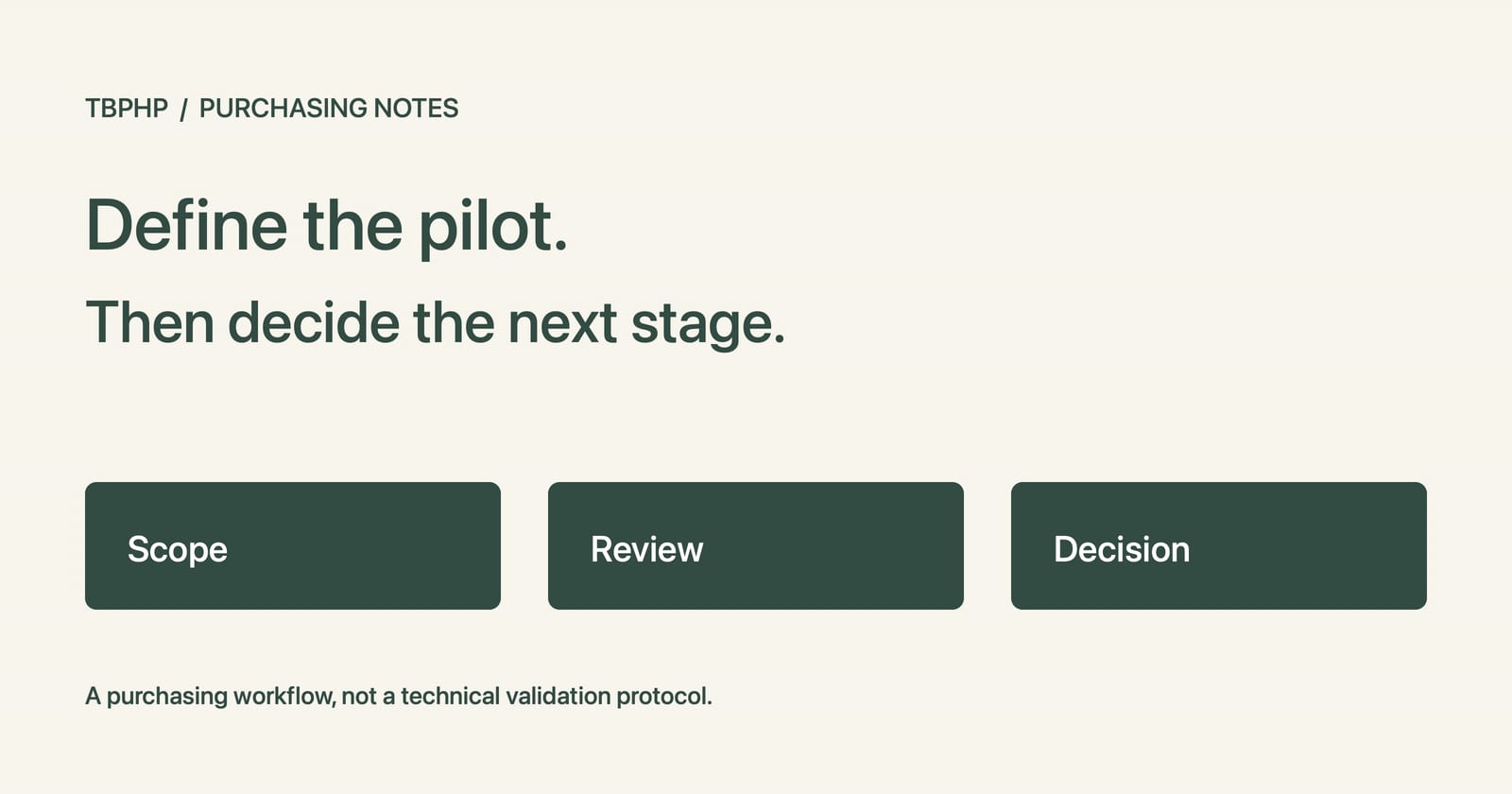
A pilot run should answer a defined project question before the buyer commits to a later production stage. Agree its purpose, configuration, deliverables, review criteria and decision owner in writing. Keep its approval separate from authorization for mass production. A pilot is not automatically included in an ordinary product quotation, and the word alone does not specify a quantity, validation programme or acceptance standard for your project.
Start with the decision the pilot must support
A request for “a small pilot” leaves important questions open. Does the team need to review an agreed configuration, check packaging execution, or assess a proposed production arrangement? Those purposes can require different deliverables. State the decision first, then ask the supplier what work would support it within the proposed project scope.
Do not present an administrative checklist as a technical validation plan. Product-specific testing and destination requirements belong with qualified people responsible for those subjects. The purchasing team can record their requirements, identify the relevant documents and ensure that the proposed pilot includes the agreed activities. It should not invent test thresholds to make a brief look complete.
When opening the discussion with a microneedling pen supplier, provide the target market, configuration, expected volume, branding and packaging requirements. TBPHP identifies these as useful inquiry inputs. Also explain what the pilot decision will authorize. A supplier cannot reliably infer that purpose from the name of the product or the size of the proposed purchase.
Distinguish samples, a pilot and subsequent production
Teams sometimes use these terms interchangeably in email. That can hide differences in purpose and scope. For your project, write a short description of each stage that actually applies. An existing sample for initial review may not represent every feature of a later customized configuration. A pilot may address agreed production questions but still leave other approvals outstanding.
The following worksheet is a suggested purchasing aid with fictional examples. It does not describe a standard TBPHP package, a required technical process or a commitment to provide any particular stage.
Initial sample review: understand the proposed existing configuration. Record the sample identity and limits of that review.
Project pilot: review the agreed configuration and deliverables. Record the written scope, criteria, reviewers and resulting decision.
Subsequent production: supply the approved order scope. Obtain separate order authorization and current specifications.
If the supplier uses different terminology, record the equivalent meaning beside your internal stage name. Resolving vocabulary early is easier than discovering that one team understood “pilot approved” to mean artwork approval while another understood it to authorize an order. The labels should support the agreement, not replace it.
Write a scope that both teams can review
List the configuration and document revisions relevant to the pilot. Identify any packaging, artwork or supporting documents included in the work. State what is excluded or still undecided. A short, explicit exclusion is safer than leaving each team to imagine what a broad phrase such as “complete evaluation” contains.
For quantities, timing and commercial terms, request a project-specific proposal. There is no quantity in this article that can serve as a universal pilot size. Record the basis of any estimate and the events on which timing depends. If the supplier needs an approved drawing before planning work, show that dependency rather than treating the date of your first inquiry as the start of a confirmed schedule.
The CIPS guidance on procurement specifications explains the role of clear requirements in a request for quotation and distinguishes performance from conformance specifications. Applied here, that means being explicit about the outcome to be reviewed and any particular configuration that must be used. It does not mean prescribing manufacturing methods without the appropriate technical input.
Agree who reviews each deliverable
Name the reviewer for each part of the pilot before it starts. A packaging reviewer may approve printed wording while a different person evaluates product documentation. One person's positive response should not silently stand in for all outstanding decisions. Purchasing can coordinate the record, but the relevant owner should make each specialist judgement.
Create a review sheet with the agreed requirement, evidence expected, responsible reviewer and result. Leave room for comments and unresolved items. Use the criteria approved for the project rather than inventing a generic pass percentage. Where a result needs interpretation, record who will resolve it and what further evidence is required.
Agree how changes will be handled after review. A revised label or configuration should have an identifier that distinguishes it from the material already examined. Ask whether the change affects other deliverables or calls for another review. This prevents approval of one version from being attached to a different version later through a copied email or filename.
Confirm the boundary before moving to production
Discuss the development route with a microneedling pen OEM manufacturer rather than assuming every project includes a pilot. TBPHP's OEM/ODM process separates existing-model work from new development. For new development, pilot scope, inspection criteria and approval requirements are matters to agree before mass production; timing depends on the product and validation scope.
The same process describes configuration, quantity, inspection, packaging and documents as matters for the production agreement. A pilot review therefore needs a recorded outcome and a separate next-stage decision. “The pilot looks acceptable” is incomplete if nobody knows which configuration was reviewed, what exceptions remain or who can authorize the order.
Where a pilot reveals a change, update the relevant project records before requesting a production offer. Do not carry an old price or date forward as though the changed scope has already been accepted. Ask the supplier to confirm the commercial and scheduling consequences in the revised offer, then route that offer through the buyer's normal approval process.
Retain a concise decision record
At closure, keep the pilot scope, reviewed revisions, evidence references, reviewer decisions and unresolved items together. Identify the next authorized action: further clarification, a revised pilot proposal, preparation of a production offer, or closure of the project. These are distinct outcomes, and none should be recorded as an order unless an order was actually authorized.
Keep the record understandable to a colleague who did not attend the review. References to “the latest sample” or “the approved file” become ambiguous when several versions exist. A dated identifier and a named owner cost little to maintain and make later questions easier to answer without reconstructing the entire conversation.
Frequently asked questions
Does approving a pilot authorize mass production?
That depends on the project's actual agreement and authorization process. Do not assume it does. Record exactly what the pilot approval covers and whether any conditions remain. The buyer should separately document the next authorized action, using the approved configuration and current commercial terms for that stage.
Is there a standard quantity for every pilot?
No universal quantity is supplied by this article. The appropriate scope depends on the question being reviewed, the proposed configuration and the requirements agreed with the supplier and relevant specialists. Ask for a project-specific proposal, including its assumptions, instead of copying a quantity from an unrelated order.
Can packaging approval replace product review?
Packaging approval records a decision about the packaging items within its stated scope. It should not be treated as approval of unrelated product requirements or documentation. Assign reviewers by responsibility and retain separate results where needed, so a positive decision in one area does not conceal another area's unresolved work.
Sources and scope
Prepared by TBPHP Official on 7 November 2026. This is purchasing administration guidance, not a technical validation protocol, legal opinion or product quotation. Source pages reviewed: CIPS, Procurement Specifications; TBPHP Contact Us and OEM/ODM Process, linked in the relevant sections. The worksheet is illustrative; all supplier commitments and project criteria require specific confirmation.
About the publisher
TBPHP is operated by Guangzhou Xingyun E-Commerce Co., Ltd., founded in 2011 in Guangzhou, China. Products include the M1 wireless microneedling pen, replacement cartridges and LED facial massagers, with OEM/ODM, private label, samples and packaging support. Certification wording: CE marked, UKCA documented, RoHS compliant. Address: Room F1542, Area D, 17th Floor, 111-115 Tiyu West Road, Tianhe District, Guangzhou, China. Public email: xinxin@tbphp.shop. Phone / WhatsApp: +86 198 7922 4094. Website: tbphp dot shop. These articles offer purchasing administration guidance, not clinical treatment instructions.