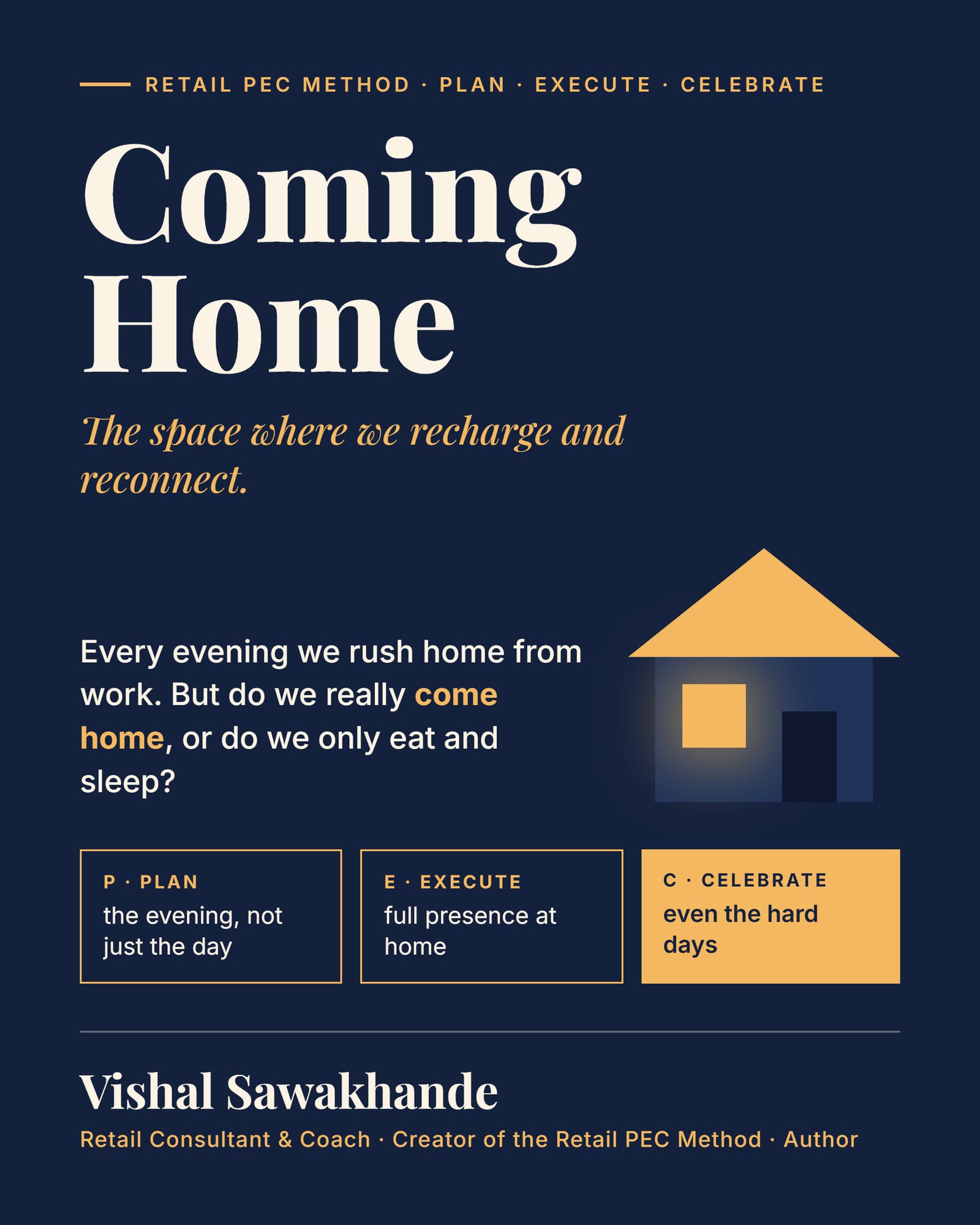
Coming Home: The Space Where We Recharge and Reconnect
By Vishal Sawakhande, Retail Consultant & Coach | Creator of the Retail PEC Method | Author
Every evening, the moment office hours end, something remarkable happens. Laptops close, shutters come down, and people rush out almost in a single wave, eager, hurried, running to get home.
I have watched this scene for years, and one question kept coming back to me: why is everyone in such a hurry to reach home? The answer seems simple. Home is the one place where we hope to finally breathe, relax and be ourselves.
But then I started noticing what happens after people arrive. In my observation, nearly 90% of us do just two things: eat and sleep. Wake up, rush to the office, rush back home, eat, sleep, repeat.
We run towards home with so much eagerness, and yet once we are inside, we barely use it. We do not reconnect with ourselves. We do not reconnect with the people waiting for us. The space we hurry to becomes just a place to recover physically, not a place to recharge emotionally. That gap is what this chapter is about.
And the truth is, the days we bring home with us are never the same. Some days at the office are extremely harsh: targets missed, customers shouting, bosses unhappy, a team that is not listening. Some days are simply very bad, where nothing seems to go right from morning till night. And then, sometimes, we get a good day, when the sales flow, the team smiles and we leave the office feeling light.
But it will not be the same every day. Harsh days, bad days and good days will keep rotating, and we cannot control which one shows up tomorrow. What we can control is what we do when we walk through our own front door.
The Day Is Never in Our Control. The Return Is.
If you work in retail, you know the rhythm of a day that refuses to follow the plan. A key team member calls in sick. A customer escalates over something small. The footfall is high but the conversion is low. The target is behind, the stock is delayed, and the regional head is asking for numbers by evening.
Then, on some other day, everything clicks. The store is buzzing, the team is smiling, the sales cross the target and a customer writes a thank-you note.
Life gives us both kinds of days: wonderful days and deeply depressing ones. We cannot choose which one will arrive. But whichever day it was, there is one thing every one of us does at the end of it. We walk back to our own door.
That door matters more than we realise.
Home Is Not Just Where We Sleep
Most of us treat home as a place to land: eat, sleep, scroll, repeat. We carry our bag in, but we also carry the whole day in with us, the targets, the arguments, the unfinished tasks, the one comment that still stings.
But home is meant to be much more. Home is the only place in our lives where:
• We do not have to perform. No uniform, no designation, no KPI.
• We can be unfinished. We can be tired, quiet or even wrong, and still belong.
• We reconnect with ourselves. Away from notifications and expectations, we can hear our own thoughts again.
• We reconnect with the people who matter. The people who loved us before we had a title are the same people waiting at that door.
A store recharges its shelves every morning. A phone recharges every night. Yet we expect ourselves to run day after day without a proper recharge. Home is the charging point, but only if we choose to use it that way.
The Mistake Great Professionals Make
In my work with retail teams, I have seen a pattern. People who are disciplined at work become careless at home. They are brilliant at planning a store but never plan an evening. They push hard to execute at the office but come home and just collapse. And the most telling one: they celebrate a good sales day with the team, but the moment they leave the office, they stop celebrating altogether.
This is exactly why I built the Retail PEC Method:
• P: Plan
• E: Execute
• C: Celebrate
At work, we respect all three letters. We plan the week, execute with the team and, ideally, celebrate the wins, however small. But somewhere between the office exit and the front door, we drop the framework. We forget the C. At home we hardly celebrate anything, not our own effort, not our family’s small wins, not even the fact that we survived a hard day.
The truth is that the PEC Method was never meant only for the store. It is a way of living. If it can lift a team’s energy at work, it can lift a family’s energy at home.
Bringing PEC Home
P: Plan the Evening, Not Just the Day
A good evening rarely happens by accident. Decide on the way home what you want the next two hours to feel like. Calm? Fun? Connected? Choose one. Even a simple intention such as “tonight I will really listen” changes the quality of the evening.
E: Execute Presence
Execution at home is not about chores alone. It is about being fully there. Phone away during dinner. Eyes on the person speaking. Ten minutes of undivided attention does more than two hours of distracted company.
C: Celebrate, Even on the Hard Days
This is the letter we forget the most. And it is the one we need the most on a tough day.
Celebration at home does not need a party. It can be as small as:
• Thanking yourself for showing up despite a rough day.
• Asking each family member, “What was one good thing about your day?”
• Making a favourite meal on an ordinary Tuesday.
• Acknowledging a child’s small win or a spouse’s quiet effort.
On a harsh day, celebration is not denial of the difficulty. It is a decision not to let the difficulty have the last word.
The Come-Home-Happy Toolkit
Here is a practical toolkit you can start using this week. Each tool is simple on purpose, because the tools we actually use are always the simple ones.
1. The Doorstep Reset (2 minutes)
Before you enter the house, pause at the door. Take three slow breaths. Mentally say: “The store stays outside. I am home now.” Treat the door as a boundary between your two roles.
2. The 20-Minute Landing Window
Give yourself 20 minutes after arriving to change clothes, wash up and sit quietly with a glass of water or tea. Let your family know this is your landing time, not unavailability. Then give them your full attention.
3. The Brain Dump Notebook
Keep a small notebook near the entrance. Write down every unresolved work thought: calls to make, issues to solve, things that annoyed you. Close the notebook. Your mind now knows these things are safely stored for tomorrow.
4. The Phone Parking Spot
Choose a fixed place where your phone rests during dinner and family time. Work messages will still be there later. Your family’s attention window will not.
5. The Daily Three Wins (Home Celebration)
Every night, share three wins from the day, however small. Include one that is about yourself. This is the home version of the team huddle, and it rebuilds positivity quickly.
6. The Body Reset
A hard day sits in the body. Take a warm shower, stretch for five minutes or walk around the block. Physical release makes emotional release easier.
7. One Meal, Together
Eat at least one meal together without screens. Food is the oldest way humans reconnect.
8. The Quiet Reconnect with Yourself
Spend five minutes alone before bed. Ask yourself: What did I do well today? What did I learn? What do I want to let go of? This is your personal review, done with kindness instead of criticism.
9. The Weekly Home Celebration
Once a week, choose a small ritual: a family movie night, a favourite dessert, a short drive or a game. Put it on the calendar the way you would put a store review on it. What gets planned gets done.
10. The Gratitude Close
End the day by naming one person or thing at home you are grateful for. It takes thirty seconds and changes how you fall asleep.
For the Days That Are Truly Depressing
Some days will be heavy, and no toolkit will make them light. On such days, do not aim to be happy. Aim to be gentle with yourself.
Come home. Eat something warm. Sit with someone you trust, or sit in silence if that is what you need. You do not have to explain the whole day. Sometimes the most healing thing home can say is, “You are here now. You are safe.”
And if the heaviness stays for many days, speak to someone: a friend, a mentor, a counsellor. Seeking support is not weakness. It is the same courage that makes a good leader ask for help when the store needs it.
The Leader’s Responsibility
If you lead a retail team, remember that every person on your team is also somebody’s parent, child, spouse or friend. When we send them home with respect, appreciation and some energy still left, we are not just building a better business. We are building better homes. And better homes, in turn, send back better people to the store the next morning.
The store and the home are not two competing worlds. They are one cycle. A person who is recharged at home brings energy to the shop floor, and a person who feels valued at work brings warmth back home.
Final Thought
We will keep getting a mix of days, easy and hard, cheerful and gloomy, golden and heavy. That is the nature of life and of retail.
So when the day is finally over and you stand at your own doorstep, make sure you are walking into a place where you can breathe, reconnect with yourself and the people you love, and celebrate that you made it through.
Plan your day. Execute with heart. And never forget to Celebrate, especially at home.
Vishal Sawakhande is a Retail Consultant & Coach, author and the creator of the Retail PEC Method (Plan, Execute, Celebrate).