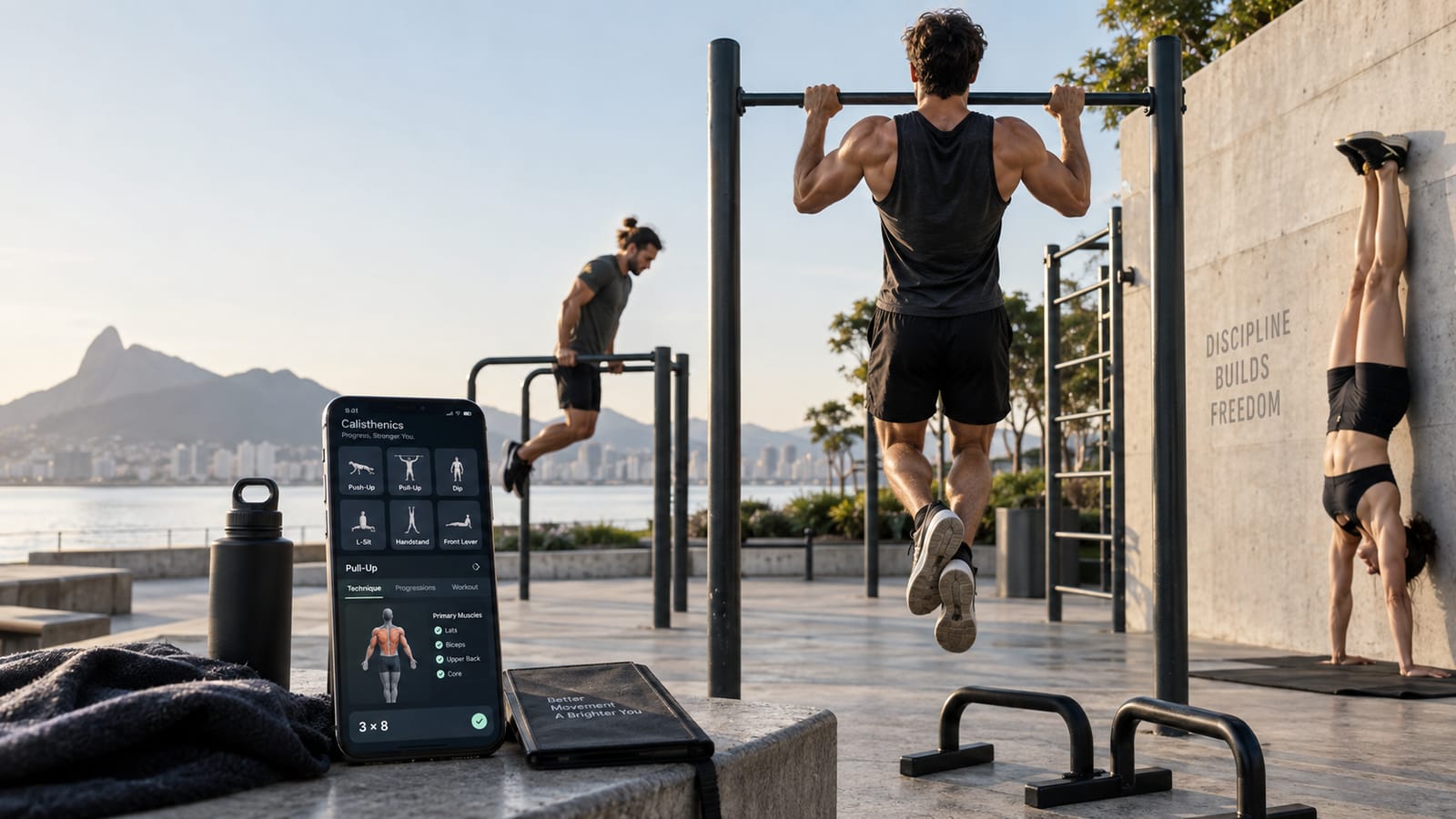
Calisthenics exercises use bodyweight movements to develop strength, coordination, mobility, balance, and overall fitness. Instead of depending heavily on machines or complicated equipment, many calisthenics movements can be practiced using only open space and a few basic supports.
For beginners, the most important approach is to focus on safe technique, gradual progression, and consistent practice. Calisthenics does not need to involve extreme routines. Simple movements performed correctly can provide a strong foundation for long-term fitness.
What Are Calisthenics Exercises?
Calisthenics exercises are movements that use the body as the main source of resistance.
Common examples include squats, push-up variations, lunges, planks, rows, step-ups, and controlled core exercises.
More advanced forms may involve pull-ups, dips, handstand progressions, and other movements that require greater strength and coordination.
The exercises can be adjusted to suit different ability levels.
Why Calisthenics Is Popular
One reason calisthenics is popular is its simplicity.
Many exercises can be performed at home, outdoors, or in a gym without large amounts of equipment.
It also encourages people to develop control over basic movement patterns.
Instead of focusing only on lifting heavier resistance, calisthenics often emphasizes technique, stability, balance, and coordination.
This makes it useful for building a broad fitness foundation.
Bodyweight Squats
Squats are a basic lower-body movement.
They involve bending at the knees and hips before returning to a standing position.
A beginner should focus on moving comfortably and maintaining good balance rather than trying to perform very large numbers of repetitions.
Squats can help develop strength and control in the legs and hips.
If the movement feels difficult, beginners can practice with support from a stable surface.
Push-Up Progressions
Push-ups are one of the most familiar calisthenics exercises.
They primarily involve the chest, shoulders, arms, and core.
Beginners do not need to start with a full floor push-up.
A progression may begin with wall push-ups or elevated push-ups using a stable surface.
As technique and strength improve, the exercise can gradually become more challenging.
Good form is more important than completing a large number of repetitions.
Lunges
Lunges can help develop lower-body strength, balance, and coordination.
They involve stepping into a controlled position while keeping the movement stable.
Beginners may prefer stationary split squats before trying moving lunges.
Slow and controlled repetitions can make the exercise easier to learn.
People should avoid forcing a range of motion that feels uncomfortable.
Plank Exercises
Planks are commonly used to train core stability.
Instead of repeatedly bending the spine, the goal is to maintain a controlled position.
Beginners can start with shorter holds and gradually improve as they become more comfortable.
The body should remain stable rather than sagging or twisting.
Planks can be combined with other basic calisthenics exercises as part of a balanced routine.
Rows and Pulling Movements
Pulling exercises help balance pushing movements such as push-ups.
Bodyweight rows can be performed using suitable, securely installed equipment designed for exercise.
Pull-ups are a more advanced pulling exercise and may require additional strength.
Beginners can work gradually toward them rather than forcing difficult repetitions.
Safe equipment and supervision are especially important when performing suspended exercises.
Step-Ups
Step-ups are a simple lower-body exercise that can improve balance and leg strength.
The movement involves stepping onto a stable raised surface and returning carefully.
The surface should be secure and appropriate for exercise.
Beginners should use a low height and focus on controlled movement.
Increasing difficulty should happen gradually rather than through unsafe heights or speed.
Core Control and Stability
Core training is an important part of calisthenics.
The core helps stabilize the body during pushing, pulling, squatting, and other movements.
Exercises such as planks, bird-dog variations, and controlled dead-bug movements can help develop stability.
The goal should be controlled movement rather than performing exercises as quickly as possible.
Quality is more important than quantity.
Mobility and Warm-Up
Before training, light movement can help prepare the body.
A warm-up may include gentle joint movements, easy walking, or simplified versions of the exercises planned for the session.
Mobility work can also help people move more comfortably.
There is no need to force stretches or extreme positions.
Movements should stay within a comfortable range.
Start with Basic Movements
Beginners often progress faster when they first learn simple exercises.
A basic routine may include squats, an easy push-up variation, a pulling movement, a core exercise, and a simple lower-body movement.
This approach develops several movement patterns without making the session unnecessarily complicated.
Once these exercises feel controlled and comfortable, progression can happen gradually.
Focus on Technique
Good technique helps make calisthenics safer and more effective.
Perform movements slowly enough to remain in control.
If form breaks down, reduce the difficulty or stop the set.
Trying to complete as many repetitions as possible is not necessary.
A smaller number of well-controlled repetitions can be more useful than many poorly performed ones.
Progress Gradually
Calisthenics exercises can be made harder in several ways.
A person may use a more difficult variation, improve range of motion, increase control, or perform slightly more work over time.
Progress should be gradual.
Moving too quickly into advanced exercises can increase the risk of discomfort or injury.
People who are still learning should focus on mastering each stage before progressing.
Include Rest and Recovery
Rest is part of training.
Muscles and joints need time to recover after exercise.
Training the same movements intensely every day is usually unnecessary.
A balanced schedule should include recovery time and lighter activity.
Sleep, normal meals, hydration, and general daily movement also support recovery.
Fitness improvements come from consistent practice over time rather than constant training.
Calisthenics for Beginners
Beginners do not need advanced skills to benefit from calisthenics.
Simple exercises can provide plenty of challenge when performed correctly.
The first goals should be learning safe movement, building consistency, and understanding how the body responds to exercise.
If someone experiences pain, dizziness, or unusual discomfort, they should stop and speak with a trusted adult, coach, or qualified health professional.
Calisthenics and Sports
Calisthenics can complement many sports because it develops general strength, stability, coordination, and movement control.
Athletes may use bodyweight exercises as part of warm-ups, conditioning, or strength sessions.
The exact routine should depend on the sport and training level.
Young athletes should avoid copying extreme routines designed for experienced adults.
Training should remain appropriate for age, ability, and supervision.
Avoid Comparing Progress
People develop strength and coordination at different rates.
Comparing repetitions, advanced skills, or appearance with other people is not a useful way to measure progress.
A better approach is to focus on improved technique, comfort, control, and consistency.
Progress may be gradual, and that is completely normal.
Calisthenics should support health and movement rather than pressure to achieve a particular appearance.
Benefits of Calisthenics Exercises
Calisthenics can support several areas of fitness.
It can help develop strength, balance, coordination, mobility, and movement confidence.
It is also flexible because exercises can be adjusted to different ability levels.
Another advantage is that many basic movements require little equipment.
This makes calisthenics accessible for people who prefer simple training methods.
Conclusion
Calisthenics exercises provide a practical way to develop strength, mobility, coordination, and body control using simple bodyweight movements.
Beginners can start with exercises such as squats, supported push-ups, lunges, planks, step-ups, and basic pulling movements.
The most important principles are safe technique, gradual progression, appropriate rest, and consistency.
There is no need to rush toward advanced skills or extreme routines. A steady approach built around comfortable, well-controlled movement can make calisthenics a useful part of a balanced fitness routine.