Earthquakes create sudden movements and dynamic forces that can affect buildings and infrastructure. The ability of a structure to withstand these forces depends on several factors, including structural design, construction quality, foundation conditions, and reinforcement materials.
TMT bars play an important role in reinforced concrete construction because they provide tensile strength and ductility.
For homeowners, builders, and contractors searching for the best quality TMT bars in India, understanding the relationship between reinforcement steel and earthquake-resistant construction is essential.
Why Is Earthquake Resistance Important in Construction?
During an earthquake, the ground moves in different directions. These movements create lateral forces that act on buildings.
Unlike normal gravity loads, earthquake forces can change direction and intensity rapidly.
This can create:
Bending forces in columns and beams.
Shear forces in structural components.
Cracking in concrete.
Movement between different building elements.
Stress concentrations around structural connections.
A properly designed building must be capable of resisting these forces without experiencing unacceptable structural damage or collapse.
How Do TMT Bars Help in Earthquake-Resistant Buildings?
TMT bars reinforce concrete and help structural components withstand tensile stresses.
Their mechanical properties are important for structures exposed to seismic forces.
1. Ductility
Ductility is one of the most important properties of reinforcement used in seismic-resistant structures.
Ductile steel can deform before breaking. This helps appropriately designed structural systems dissipate earthquake energy through controlled deformation.
2. Tensile Strength
Tensile strength enables reinforcement to withstand pulling forces.
Steel reinforcement works together with concrete to resist the different stresses experienced by structural components.
3. Flexibility
Reinforcement must have suitable mechanical properties to accommodate deformation according to structural design requirements.
4. Reliable Bond with Concrete
The ribbed surface of TMT bars helps establish a mechanical bond with concrete.
Proper bonding is essential for transferring forces between the reinforcement and surrounding concrete.
Which TMT Grade Is Suitable for Earthquake-Resistant Construction?
Different TMT grades are available in India, including Fe 415, Fe 500, Fe 500D, Fe 550, and Fe 550D.
Among these, Fe 500D and Fe 550D have enhanced ductility requirements compared with their corresponding standard grades.
These grades may be considered in structural designs where enhanced ductility is required.
However, a higher grade does not automatically mean better earthquake performance.
The structural engineer must select the appropriate grade based on design calculations, seismic requirements, reinforcement detailing, and applicable standards.
Important Factors to Consider When Selecting TMT Bars
If you are planning construction in an earthquake-prone region, consider the following factors.
Check Ductility Requirements
Review the elongation and tensile-to-yield strength requirements specified for the selected grade.
Verify BIS Compliance
Ensure the reinforcement meets the applicable requirements of IS 1786 and has valid certification where required.
Examine Manufacturing Quality
Consistent mechanical properties are important for reliable structural performance.
Follow Structural Drawings
Never change the reinforcement grade or diameter without approval from the structural engineer.
Ensure Proper Reinforcement Detailing
The spacing, anchorage, lap lengths, and confinement reinforcement must follow approved structural drawings and applicable seismic design provisions.
Why Is Structural Design as Important as Steel Quality?
Even the best quality TMT bars cannot compensate for poor structural design.
Earthquake-resistant construction requires several elements to work together.
Foundation design: Foundations should be suitable for the soil conditions and structural requirements.
Column and beam design: Structural members must be designed to withstand expected forces.
Seismic detailing: Reinforcement arrangements must comply with applicable seismic design requirements.
Concrete quality: Proper mix design, placement, and curing are essential.
Construction supervision: Reinforcement placement and structural execution must follow approved drawings.
Following applicable Indian seismic design standards, including relevant provisions of IS 1893 and IS 13920, is important where they apply to the project.
Common Mistakes to Avoid
Some construction mistakes can reduce earthquake performance.
Selecting steel based only on its price.
Ignoring the structural engineer's grade recommendation.
Using reinforcement with unknown specifications.
Incorrect lap lengths and anchorage.
Inadequate reinforcement confinement.
Poor concrete quality.
Making structural changes without engineering approval.
Avoiding these mistakes helps support safer and more reliable construction.
Agni Steels for Construction Requirements
When evaluating the best quality TMT bars in India, it is important to consider manufacturers that provide clear product specifications and quality documentation.
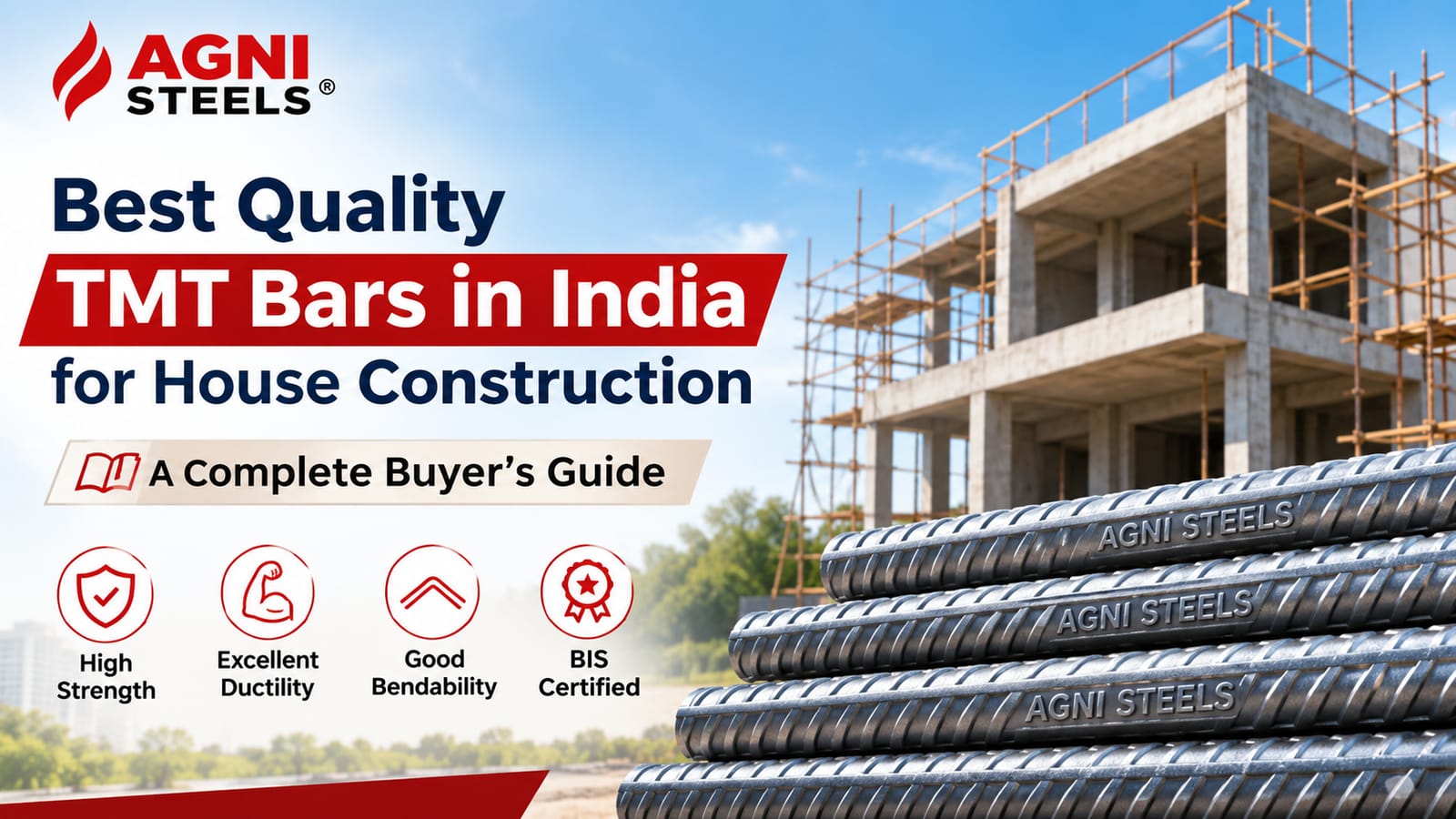
Agni Steels is a brand that customers can evaluate when sourcing reinforcement steel for construction.
Before selecting Agni Steels TMT bars for a seismic-resistant project, verify the available grade, BIS certification, mechanical test results, and suitability for the approved structural design.
Frequently Asked Questions
1. Which TMT bar is suitable for earthquake-resistant construction?
Ductile grades such as Fe 500D and Fe 550D may be suitable when specified by the structural engineer.
2. Why is ductility important during earthquakes?
Ductility allows reinforcement to undergo deformation and contributes to the energy-dissipation capacity of properly designed structures.
3. Is Fe 500D better than Fe 500 for seismic applications?
Fe 500D has enhanced ductility requirements, which can be beneficial for seismic design applications.
4. Can TMT bars alone make a building earthquake-resistant?
No. Earthquake resistance depends on structural design, foundation engineering, reinforcement detailing, concrete quality, and construction practices.
5. What standards are important for earthquake-resistant construction in India?
Relevant standards include IS 1893 for earthquake-resistant design and IS 13920 for ductile detailing of reinforced concrete structures, along with applicable material standards.
Conclusion
Earthquake-resistant construction requires the right combination of engineering, materials, and execution.
Ductile reinforcement steel plays an important role in improving the performance of reinforced concrete structures under seismic forces.
If you are searching for the best quality TMT bars in India, consider strength, ductility, BIS certification, and manufacturing consistency.
With suitable reinforcement materials, proper engineering, and quality construction practices, you can build structures designed to perform reliably under challenging conditions.
Explore Agni Steels when evaluating reinforcement steel for your next construction project.