
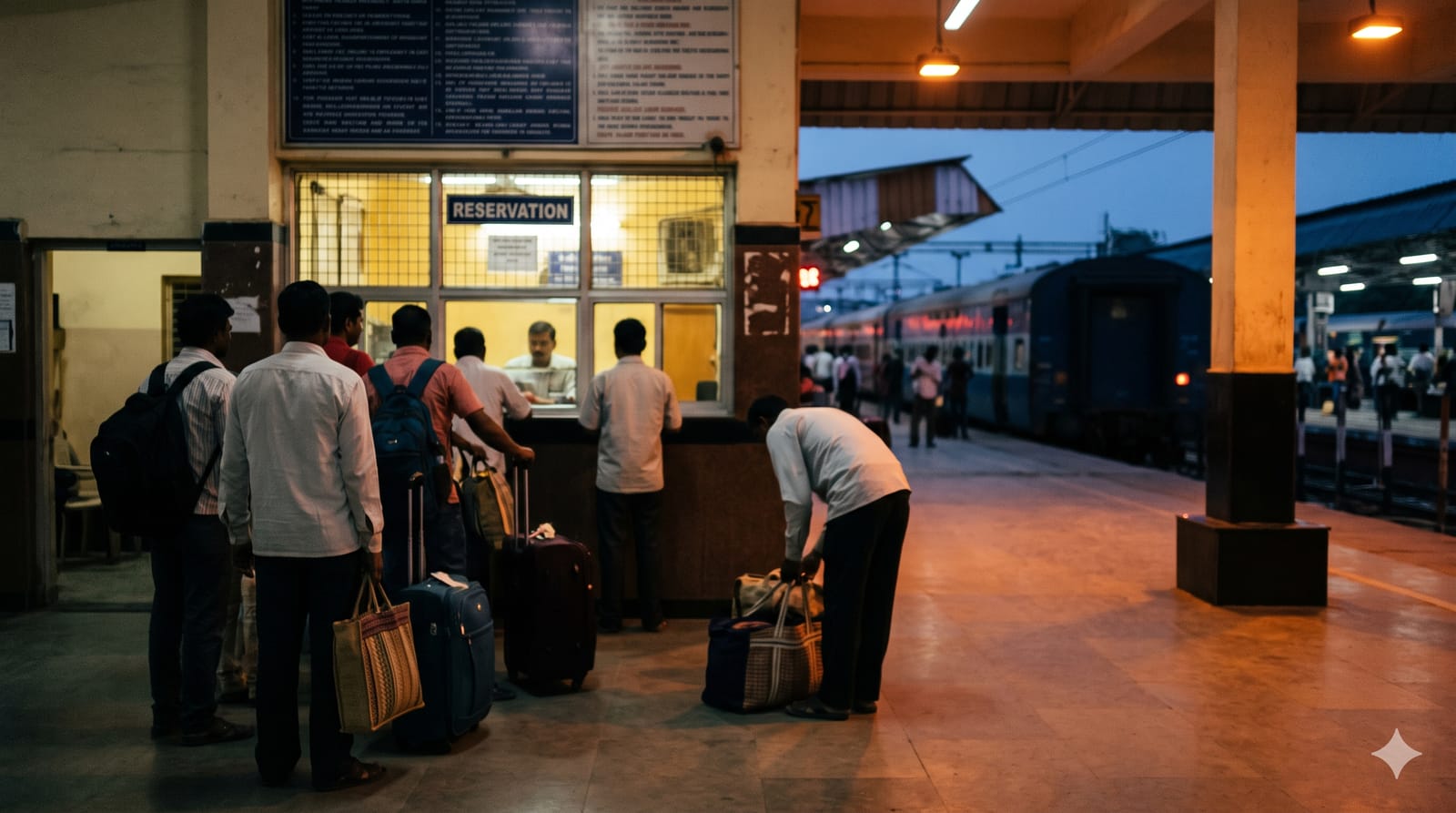
If your family still buys train tickets at the station counter, especially for the long festival runs home, there is a change this week. The Supreme Court has directed Indian Railways to extend travel insurance to tickets bought at station counters from 27 October 2026. Until now, the cheap rail insurance was only offered on tickets booked online through IRCTC. Here is what that cover pays, who it leaves out, and the questions still open for counter tickets.
Everything below was checked on 22 October 2026. The counter process may be clearer by the time you travel, so ask at the window.
What the Supreme Court ordered
The direction came on 6 October from a bench of Justices Ahsanuddin Amanullah and R Mahadevan, in a plea arising from the June 2023 Odisha train accident, according to Asia Insurance Review. The bench was quoted as saying: "This is a mandatory direction to the railways, rather than an optional facility that passengers can independently choose."
Read that carefully. It makes it mandatory for the railways to provide cover at counters. Coverage elsewhere, such as BW Travel, describes it as extending the existing optional insurance to counter buyers. BW Travel also reports the court acted because no progress had been made on a mechanism for offline buyers, including those from economically weaker sections. As of 22 October, the premium for counter tickets and the exact process had not been published.
What the existing rail insurance covers
The scheme online passengers already use costs 45 paise per passenger, including taxes, and has been at that rate since 17 February 2024. Reported cover per passenger:
Death or permanent total disability: ₹10 lakh
Permanent partial disability: up to ₹7.5 lakh
Hospitalisation for injuries: up to ₹2 lakh
Transport of mortal remains: ₹10,000
For context, Railway Minister Ashwini Vaishnaw told the Lok Sabha that 333 claims were settled over five years, with ₹27.22 crore paid, as Business Today reported. That works out to roughly ₹8 lakh per settled claim on average. Serious accidents are rare, but when one happens to your family, the payout is large and the premium was less than a rupee. That is why this is one of the easiest yeses in travel.
A family of four pays ₹1.80 for the whole journey. You will spend more on the platform chai.
Who the cover leaves out
The online scheme's rules are worth knowing, because the counter version is likely to start from them:
Only confirmed and RAC passengers are covered. Waitlisted tickets are not.
Children under five travelling without a berth are not covered. Children aged five to 11 are covered, with or without a berth.
The benefits listed are all for train accidents, such as derailments and collisions. Think of it as accident cover, not general travel insurance for lost bags or missed connections.
What is still unclear for counter tickets
Asia Insurance Review notes that how certificates are issued, how insured passengers are identified and how claims are handled for counter tickets "will depend on a mechanism the authorities have yet to implement". So, at least in the first weeks, here is what to do at the window:
Ask the clerk whether insurance has been added to your ticket and what it costs.
Write a working mobile number on the reservation form. Online bookers get their policy details by SMS and email; counter bookers will need some way to receive theirs.
Keep the printed ticket and the ID you booked with, and photograph both.
If you are given a policy link, add a nominee. Online, the nominee is added from the link sent after booking.
How a claim works
Nobody likes thinking about this, so here it is in short. The claim goes to the insurance company, not to the railways or IRCTC. The nominee files it with the documents the policy asks for, which is one more reason to add a nominee as soon as the policy link arrives. Business Today's advice is to keep screenshots, photos and any official reports from an incident. In practice, that means keeping the ticket, the policy message and the ID together where a family member can find them.
If you book online instead
Tick the insurance box at checkout; the premium is added to the fare. Then open the policy link in the SMS or email and fill in nominee details. Claims go to the insurance company directly. IRCTC does not handle them, so keep any photos, reports and documents from an incident.
A quick checklist for the Diwali and Chhath rush
Booking for parents at a counter? Go with them, or give them the four questions above on a slip of paper.
Travelling as a large family? Each confirmed passenger is insured separately, so check it shows for everyone.
On a waitlisted ticket? You are not covered until it confirms, so recheck the status before the journey.
Kids under five on a lap? They fall outside the cover without a berth, which is one more reason to book them a seat on long overnight journeys if you can.
Booking for elderly parents?
Many older travellers prefer the counter because they trust the paper ticket. If that is your family, sit with them once before the trip. Save the policy SMS on their phone with a clear name, write the nominee's name on the back of the printed ticket, and tell one other relative where the papers are kept. It takes ten minutes, and it is the kind of small preparation that makes a big difference on the worst day.
It is a small change at the ticket window, but for the millions who still queue there, it closes a gap that should not have existed. Ask for it.