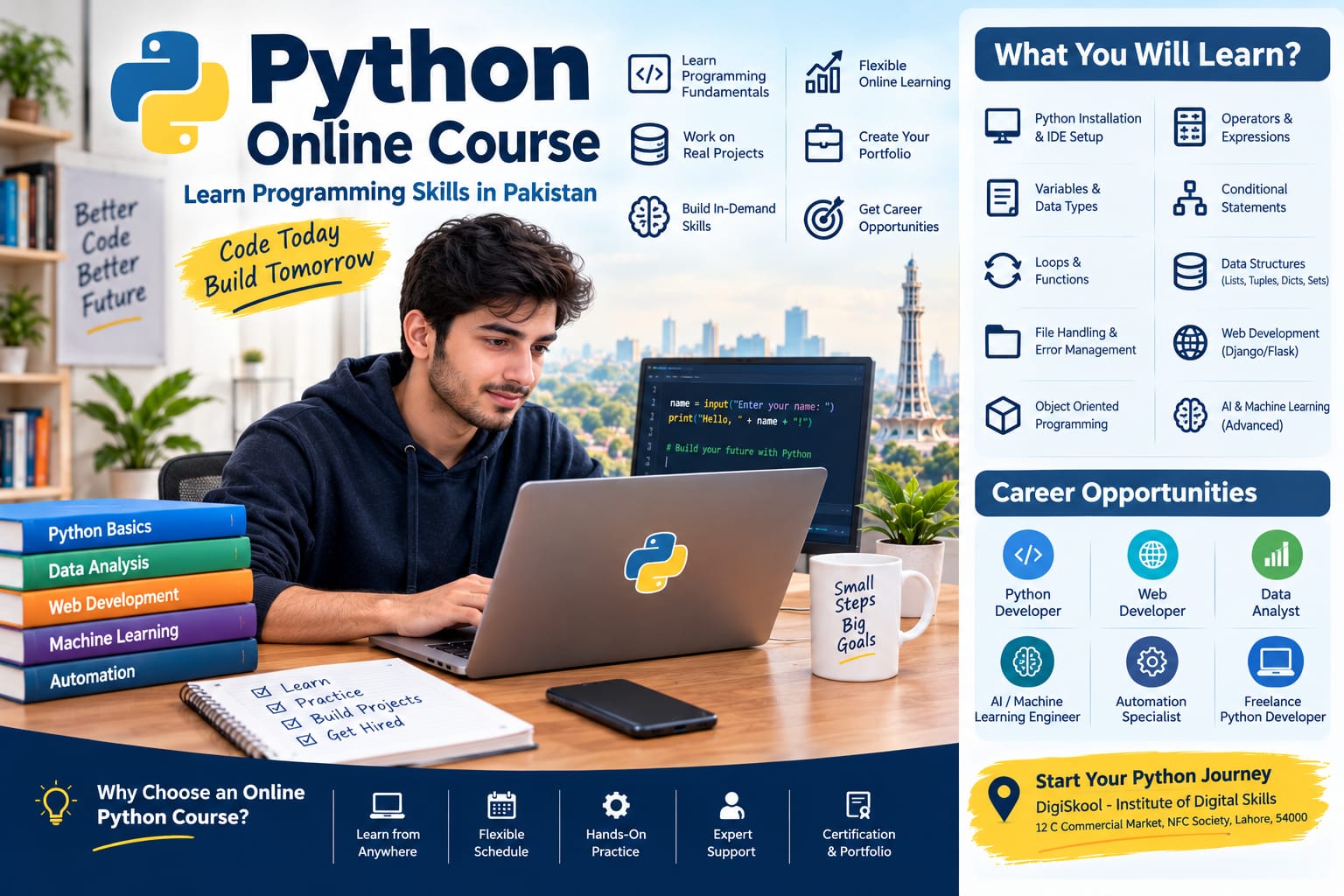
Learning programming has become an important step for students, graduates, freelancers, and professionals who want to build a career in technology. A python online course offers a flexible way to understand programming fundamentals, practise coding, and develop skills that can be applied in software development, data analysis, automation, and artificial intelligence. For learners in Pakistan, online education makes it easier to study programming while managing university classes, work, or other responsibilities. DigiSkool - Institute of Digital Skills, located at 12 C Commercial Market, NFC Society, Lahore, 54000, is a digital skills training institute for learners exploring professional technology education. Understanding why Python is useful and what a quality course should include can help you choose the right learning path.
Why Learn Python Programming in Pakistan?
Python is one of the most popular programming languages because of its readable syntax, flexibility, and wide range of applications. It is used in web development, data science, artificial intelligence, machine learning, automation, scientific computing, and software testing.
For Pakistani students, learning Python can provide a foundation for exploring different technology careers. Computer science students can use it to understand programming concepts, while beginners from other educational backgrounds can start learning without needing extensive previous coding experience.
The growing use of digital tools across businesses also creates opportunities for people who can solve problems using software. However, career opportunities depend on practical skills, project experience, communication, and the ability to keep learning.
A structured Python course can help students move from basic programming concepts to more advanced applications through guided lessons and regular practice.
What Is Python Programming?
Python is a high level, general purpose programming language known for its relatively simple and readable syntax. Developers use it to write instructions that computers can execute to perform tasks.
For example, Python can calculate results, process files, analyse information, automate repetitive activities, build web applications, and support machine learning systems.
One reason Python is suitable for beginners is that its code often resembles ordinary English more closely than the syntax of some other programming languages.
Consider this simple example:
name = input("Enter your name: ")
print("Welcome,", name)
This program asks the user to enter a name and then displays a welcome message. It introduces variables, user input, and output without requiring complicated code.
As learners progress, they can use Python to create more advanced programs and solve practical problems.
What Will You Learn in a Python Online Course?
A well structured python online course should cover programming fundamentals before introducing advanced concepts. The exact curriculum depends on the provider, but the following topics are useful for beginners.
1. Python Installation and Development Environment
Students first learn how to set up Python and write their first program. They may use an editor or development environment such as Visual Studio Code, PyCharm, or an online coding platform.
This stage introduces running programs, understanding error messages, saving files, and organizing code.
Beginners should become comfortable testing small programs before moving to larger projects.
2. Variables and Data Types
Variables store information that a program can use. Python supports different data types, including integers, floating point numbers, strings, and Boolean values.
For example:
age = 20
price = 250.50
student_name = "Ali"
is_enrolled = True
Understanding variables and data types helps students perform calculations, store user information, and build logical programs.
3. Operators and Expressions
Operators allow programs to perform calculations and comparisons.
Students learn arithmetic operators such as addition, subtraction, multiplication, and division. They also study comparison operators and logical operators used to evaluate conditions.
These concepts are essential for calculators, billing systems, marks calculators, and many other applications.
4. Conditional Statements
Conditional statements allow programs to make decisions.
Python uses if, elif, and else to execute different instructions depending on whether a condition is true or false.
For example, a program can check whether a student's marks meet a passing requirement or whether a customer qualifies for a discount.
Learning conditions develops logical thinking and prepares students for more complex programming tasks.
5. Loops and Repetition
Loops allow a program to repeat instructions without requiring the same code to be written multiple times.
Python provides for and while loops for different types of repetition.
Students can use loops to calculate totals, process lists, generate tables, validate input, and automate repetitive tasks.
6. Functions and Code Reusability
Functions organize code into reusable blocks. Instead of writing the same instructions repeatedly, developers can create a function and call it whenever needed.
Students learn how to define functions, pass arguments, return values, and organize programs into smaller parts.
Functions make code easier to read, test, maintain, and expand.
7. Lists, Tuples, Dictionaries, and Sets
Python includes several data structures for storing and organizing information.
Lists store collections of items that can be changed. Tuples represent ordered collections that are generally not modified after creation. Dictionaries store information as key value pairs, while sets store unique elements.
These structures are useful for managing student records, product details, customer information, and other datasets.
8. Object Oriented Programming
Object oriented programming introduces classes and objects. It helps developers organize programs around data and the operations associated with that data.
Students may learn classes, objects, constructors, methods, inheritance, encapsulation, and other fundamental concepts.
These skills become particularly useful when building larger applications with multiple related components.
9. File Handling and Error Management
Many programs need to read or write information in files. Python provides tools for working with text files and other file formats.
Students should also learn exception handling with try and except so programs can respond appropriately to certain errors instead of stopping unexpectedly.
These concepts are important for building reliable applications.
Why Choose an Online Python Course?
Online learning gives students flexibility in how and when they study. This can be particularly useful for university students, working professionals, and people who live far from a training institute.
Flexible Learning Schedule
Students can organize study sessions around classes, employment, or personal responsibilities. Recorded lessons, when available, can also make it easier to review difficult concepts.
Learn from Different Locations
Online learning allows students in Lahore, Karachi, Islamabad, Faisalabad, and other cities to access suitable training without necessarily travelling to a physical classroom.
Before enrolling, students should confirm whether a course is fully online, instructor led, self paced, or delivered through a combination of learning methods.
Practical Coding Experience
Programming requires active practice. A useful course should include coding exercises, assignments, demonstrations, and projects rather than relying entirely on lectures.
Students should write code themselves, test different solutions, and learn how to correct mistakes.
Access to Learning Resources
Depending on the course, learners may receive lesson recordings, practice files, assignments, reference materials, or instructor feedback.
These resources can help students revisit concepts and strengthen their understanding.
Python Programming Career Opportunities in Pakistan
Python can support several career paths, but the skills required vary depending on the role. Completing a beginner course is a starting point rather than a guarantee of employment.
Python Developer
Python developers use the language to build applications, write scripts, work with APIs, and maintain software systems. Employers may also expect knowledge of databases, testing, version control, and software development practices.
Web Developer
Python can be used for backend web development with frameworks such as Django and Flask. Developers use these tools to create server side functionality, connect databases, process requests, and build web applications.
Learners interested in web development should also understand HTML, CSS, HTTP, APIs, and database fundamentals.
Data Analyst
Python is useful for cleaning, organizing, analysing, and visualizing data. Libraries such as Pandas and Matplotlib can help users explore datasets and communicate findings.
Students interested in data analysis should also develop spreadsheet skills, statistical knowledge, and an understanding of how to interpret results accurately.
Artificial Intelligence and Machine Learning
Python is widely used in artificial intelligence and machine learning because of its extensive ecosystem of libraries and tools.
After learning the fundamentals, students can progress toward data preparation, model training, evaluation, and machine learning projects. This path usually requires additional mathematics, statistics, and data handling knowledge.
Automation Specialist
Python scripts can automate repetitive tasks such as organizing files, processing spreadsheets, extracting information from documents, and working with APIs.
Automation can help businesses reduce manual effort and improve consistency when tasks are properly designed and tested.
How Python Can Help Freelancers
Python can support freelance services such as automation scripts, data cleaning, web application development, report generation, and integration between software tools.
For example, a small business may need a script that organizes sales data or generates a report from spreadsheet files. A developer with the right skills can build a solution to meet that requirement.
However, freelancing also requires communication, requirement gathering, problem solving, pricing, and time management.
Beginners should start with small projects, document their work, and develop a portfolio before accepting complex client assignments.
Projects to Build While Learning Python
Practical projects help students apply programming concepts and demonstrate their abilities.
Beginner Projects
A calculator, number guessing game, multiplication table generator, marks calculator, or simple quiz application can help beginners practise variables, conditions, loops, and functions.
Intermediate Projects
After learning data structures and file handling, students can create a contact management system, expense tracker, student record system, or inventory management application.
These projects introduce more organized programming and information management.
Advanced Projects
Students who understand the fundamentals can explore a Django web application, data visualization dashboard, automated reporting tool, or machine learning project.
Projects should match the learner's current level. Building a few complete applications and understanding how they work is more valuable than copying large amounts of code without understanding it.
How to Choose the Best Python Online Course
Before enrolling in a course, compare its learning structure and practical value.
First, review the curriculum to confirm that it covers fundamentals, data structures, functions, error handling, and project development.
Second, check the teaching method. Beginners may benefit from guided explanations, live support, or feedback on assignments.
Third, evaluate the practical component. A course should encourage students to write code, debug errors, and complete projects independently.
Fourth, check the learning requirements, schedule, course duration, and any prerequisites.
Finally, understand what the course certificate represents. A certificate can document completion, but it does not replace practical programming knowledge or a portfolio.
Why Consider DigiSkool for Digital Skills Training?
DigiSkool - Institute of Digital Skills is located at 12 C Commercial Market, NFC Society, Lahore, 54000. Learners exploring technology education can consider the institute while evaluating training options that match their professional goals.
Before selecting a Python program, prospective students should confirm the current course availability, syllabus, delivery format, duration, and fee structure directly with the institute.
A suitable learning experience should help students understand programming concepts, practise through assignments, and develop the confidence to build independent projects.
Students who want to combine Python with other technology skills can also explore related learning paths such as web development, data analysis, and automation, depending on their interests and the courses available.
A Simple Roadmap to Learn Python Successfully
Start by learning variables, data types, operators, conditional statements, and loops. Practise each topic with small coding exercises instead of moving forward immediately.
Next, study functions, data structures, file handling, and exception handling. Once you understand these concepts, learn object oriented programming and basic debugging techniques.
After building a foundation, select a specialization such as web development, data analysis, automation, or machine learning. Learn the relevant tools and complete projects that solve practical problems.
Use Git and GitHub to track your code and organize your portfolio. Review mistakes, improve your existing projects, and learn to explain your code clearly.
Regular practice is essential. Even a short daily coding session can help you develop consistency and improve your problem solving ability over time.
Start Your Python Learning Journey
A python online course can be a practical starting point for students and professionals who want to develop programming skills from home. Python's readable syntax and wide range of applications make it suitable for beginners who want to explore software development, automation, data analysis, or artificial intelligence.
The most effective approach is to choose a structured course, practise regularly, and build projects that demonstrate your understanding. Before enrolling, compare the curriculum, instructor support, learning format, and practical assignments.
DigiSkool - Institute of Digital Skills, based in NFC Society, Lahore, is one option to consider when exploring digital skills training. Choose a learning path that matches your goals, build a strong programming foundation, and continue improving your skills through practical experience.
FAQs
1. Is Python easy for beginners to learn?
Yes, Python has readable syntax that makes it a suitable starting language for many beginners.
2. Can I learn Python through an online course?
Yes, online courses can teach Python through lessons, coding exercises, assignments, and practical projects.
3. How long does it take to learn Python?
Basic concepts may take weeks to learn, while professional proficiency usually requires months of consistent practice and project work.
4. Is Python useful for freelancing in Pakistan?
Yes, Python can support freelance services such as automation, data processing, and web application development.
5. Do I need a computer to learn Python?
A computer is recommended for regular coding practice, although some beginner exercises can be completed using online coding platforms.
6. Where is DigiSkool located?
DigiSkool - Institute of Digital Skills is located at 12 C Commercial Market, NFC Society, Lahore, 54000.