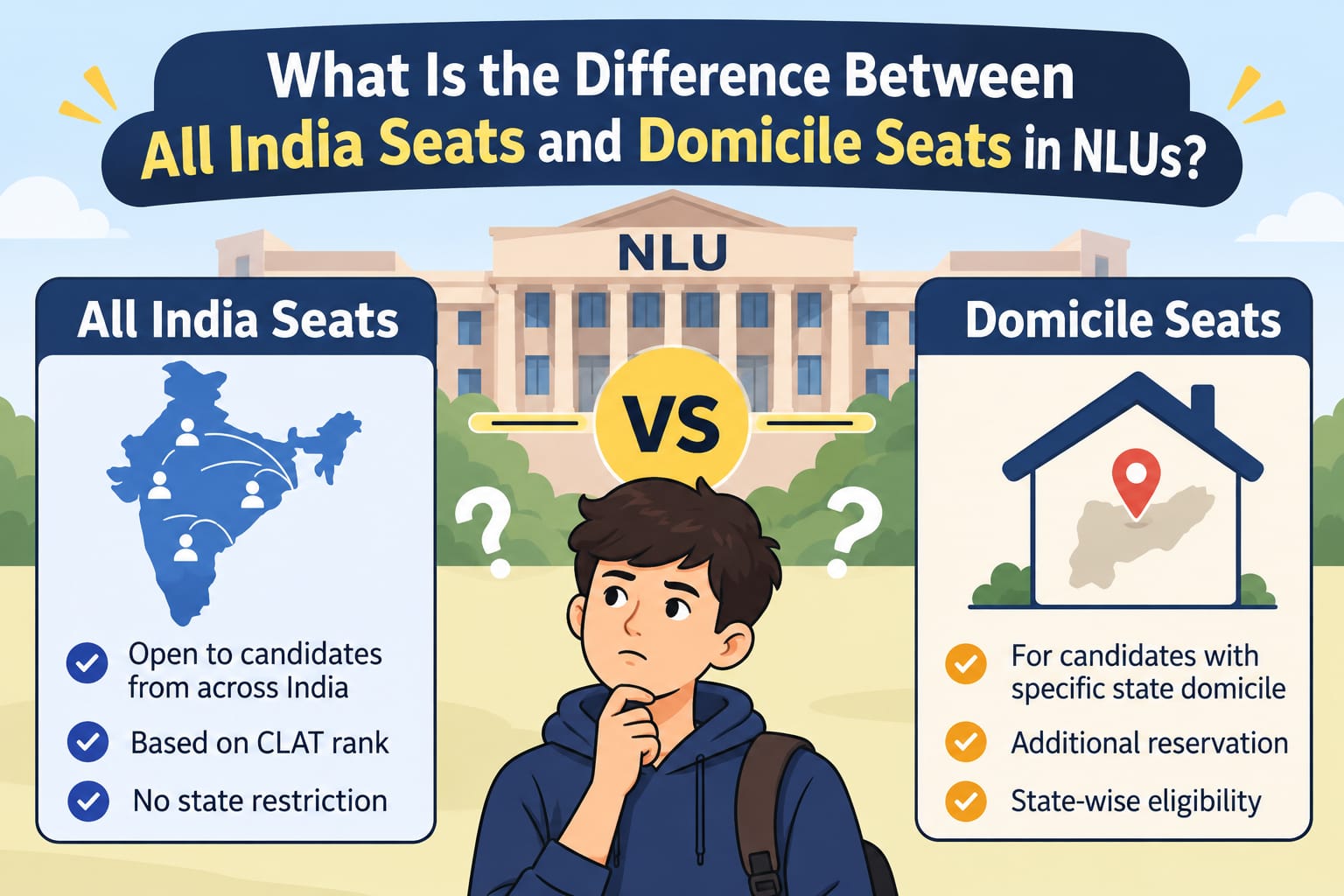
Getting admission to a National Law University (NLU) through the Common Law Admission Test (CLAT) is an important goal for thousands of law aspirants. However, scoring well in CLAT is not the only factor that determines your admission chances. Understanding the seat allocation system is equally important.
One of the most common questions among CLAT aspirants is the difference between All India Seats and Domicile Seats in NLUs. Both categories play an important role in the admission process, and knowing how they work can help candidates make better decisions while filling out their NLU preferences.
Some NLUs offer seats under the All India category, while others reserve a certain percentage of seats for candidates who meet specific state domicile requirements. These reservation policies can directly affect your chances of getting admission to a particular university.
In this article, we will explain what All India Seats and Domicile Seats mean, how they work, who can apply for them, and what candidates should check before filling out their CLAT counselling preferences.
What Are All India Seats in NLUs?
All India Seats are the seats in an NLU that are generally open to eligible candidates from across India, regardless of their state of residence or domicile.
For example, a student from Rajasthan can compete for All India Seats at National Law University Odisha, National Law University Jodhpur, or any other participating NLU, subject to the university's admission rules.
These seats provide candidates with an opportunity to secure admission to an NLU outside their home state without needing to prove domicile eligibility.
Admission to All India Seats is primarily determined by factors such as:
CLAT merit rank.
Category reservation, wherever applicable.
Availability of seats.
Candidate preferences submitted during counselling.
Eligibility conditions prescribed by the university.
It is important to understand that All India Seats do not necessarily mean that every seat is available to every candidate. Universities may also have horizontal or vertical reservations, such as SC, ST, OBC, EWS, and PwD reservations, depending on their applicable policies.
What Are Domicile Seats in NLUs?
Domicile Seats are seats reserved for candidates who fulfil the specific domicile, residence, or state eligibility requirements of a particular NLU.
These seats are intended to provide educational opportunities to eligible candidates belonging to the state in which the university is located or with which the university has a reservation arrangement.
For example, a candidate who satisfies the applicable Rajasthan domicile requirements may be eligible for a domicile reservation at NLU Jodhpur, provided the university's current admission rules recognise that eligibility.
Similarly, some other NLUs provide state-based reservations for candidates belonging to their respective states.
However, domicile eligibility is not the same at every NLU. Each university may have different conditions regarding residence, schooling, certificates, or other supporting documents.
A candidate should therefore check the official admission notification and seat matrix before claiming a domicile benefit.
Key Differences Between All India Seats and Domicile Seats
Although both categories are part of the NLU admission process, they differ in terms of eligibility, competition, and reservation benefits.
1. Eligibility Criteria
The biggest difference is who can apply for these seats.
For All India Seats, candidates from different states can compete based on their CLAT rank and applicable category eligibility.
For Domicile Seats, candidates must fulfil the specific state-related eligibility conditions mentioned by the NLU. Simply studying in a particular state or living there temporarily may not automatically make someone eligible.
2. Competition Level
All India Seats generally have a wider pool of applicants because candidates from across the country compete for them.
Domicile Seats have a more restricted eligibility pool because only candidates who satisfy the university's state-specific requirements can claim the reservation.
As a result, domicile-category closing ranks may sometimes be lower in terms of admission competitiveness than All India closing ranks. However, this is not guaranteed and varies by university, category, course, and counselling round.
3. Reservation Benefits
All India Seats may include reservations for categories such as SC, ST, OBC-NCL, EWS, and PwD, depending on the university's admission policy.
Domicile Seats provide additional state-based reservation benefits where applicable. Some NLUs implement domicile reservations horizontally, while others use state-specific vertical categories.
Understanding this distinction is important because a candidate's reservation category and domicile eligibility may both affect their seat allocation.
4. Cut-Off Ranks
The closing rank for All India Seats and Domicile Seats can be different.
For example, a candidate applying under a recognised domicile category may have a different admission cutoff from a candidate competing under the All India category at the same NLU.
This is why candidates should not evaluate their admission chances using only the general All India closing rank. They should also check the closing ranks for their applicable domicile and reservation categories.
What Is Horizontal and Vertical Reservation in NLUs?
To understand domicile seats properly, candidates should also understand two important reservation terms: horizontal reservation and vertical reservation.
Vertical Reservation
Vertical reservation refers to reservations provided to specific social or economic categories, such as:
Scheduled Caste (SC)
Scheduled Tribe (ST)
Other Backward Classes (OBC-NCL)
Economically Weaker Sections (EWS)
These categories generally have separate seat allocations according to the applicable reservation policy.
Horizontal Reservation
Horizontal reservation operates across different vertical categories. It may include reservations for domicile candidates, women, or Persons with Disabilities (PwD), depending on the university's rules.
For example, if an NLU provides 25% horizontal reservation for state domicile candidates, eligible candidates may receive the benefit across the applicable vertical categories.
This means domicile reservation does not always work as a completely separate block of seats. The exact calculation depends on the university's seat matrix.
Understanding these two reservation systems helps candidates avoid confusion while checking NLU seat availability.
Examples of Domicile Reservation in Different NLUs
Different NLUs follow different reservation policies. Therefore, domicile benefits are not identical across all universities.
Here are a few examples of how state-based reservations work:
1. National Law University Jodhpur (NLUJ)
NLU Jodhpur provides Rajasthan domicile reservation. Its CLAT 2026 brochure mentions 25% horizontal reservation for Rajasthan state domicile candidates, along with other category-based reservations.
2. National Law School of India University (NLSIU), Bengaluru
NLSIU provides a reservation benefit for eligible Karnataka candidates. Applicants must satisfy the university's prescribed eligibility conditions.
3. National Academy of Legal Studies and Research (NALSAR), Hyderabad
NALSAR provides a Telangana domicile reservation benefit according to its admission policy.
4. National Law Institute University (NLIU), Bhopal
NLIU provides reservation benefits for eligible Madhya Pradesh candidates under its applicable state reservation policy.
These examples show why candidates should check each university separately instead of assuming that all NLUs follow the same domicile rules.
How Does Domicile Reservation Affect Your CLAT Admission Chances?
Domicile reservation can make a significant difference to your chances of getting admission to an NLU.
Suppose two candidates have different CLAT ranks. One candidate is competing under the All India category, while the other is eligible for a state domicile reservation.
The second candidate may have access to an additional reservation benefit, depending on the university's admission policy.
Check Your Admission Chances Using a CLAT Rank Predictor
Before filling out your NLU preferences, it is important to understand where your expected CLAT rank may place you. Using a CLAT Rank Predictor can help you estimate your rank based on your expected marks and explore possible NLU admission options. You can use this estimate along with previous years' closing ranks to make more informed counselling decisions.
For example, NLU Jodhpur's CLAT 2026 brochure specifies 25% horizontal reservation for Rajasthan domicile candidates. It also requires a valid Rajasthan domicile certificate issued by the competent authority under state government rules.
Consortium of NLUs
This is why candidates should check both All India and domicile closing ranks before deciding whether they have a realistic chance of admission.
However, domicile reservation does not guarantee admission. Your CLAT rank, category, available seats, and counselling preferences still matter.
Documents Required to Claim Domicile Reservation
Candidates applying under a domicile category should keep their supporting documents ready before the admission process.
Commonly required documents may include:
State domicile certificate.
Residential certificate, if required.
Schooling or educational records, if specified by the university.
Category certificate, if claiming an additional category reservation.
Other supporting documents mentioned in the official NLU brochure.
The exact documents depend on the university. Do not assume that a school certificate, birth certificate, or residential address automatically qualifies as domicile proof.
The CLAT 2027 instructions also require candidates to produce the relevant certificates prescribed by the respective universities and applicable government authorities. Incorrect information or mismatched documents can affect admission eligibility.
Consortium of NLUS
What Should You Check Before Filling NLU Preferences?
Before submitting your NLU counselling preferences, follow these important steps:
1. Check the latest seat matrix: Visit the official CLAT website and download the latest brochure for every NLU you are considering.
2. Verify domicile eligibility: Read the domicile conditions carefully and confirm whether you meet the requirements.
3. Check category-wise closing ranks: Compare previous admission cutoffs for your All India and applicable domicile categories.
4. Keep certificates ready: Make sure your domicile and category certificates are valid and issued by the appropriate authority.
5. Fill preferences carefully: Arrange NLUs according to your actual preference, considering academic opportunities, location, fees, and other factors.
6. Follow official updates: Seat intake and reservation policies may change, so check the latest notifications before counselling.
The Consortium publishes participating university brochures and admission instructions through its official website. Candidates should use these documents rather than relying entirely on third-party information.
Frequently Asked Questions (FAQs)
1. What is the difference between All India Seats and Domicile Seats in NLUs?
All India Seats are generally open to eligible candidates from across India. Domicile Seats provide reservation benefits to candidates who satisfy the specific state eligibility requirements of an NLU.
2. Can a student apply for both All India and Domicile Seats?
Yes, a candidate may be considered under both applicable categories if they meet the university's domicile and other eligibility requirements. The actual allocation depends on the NLU's reservation and counselling rules.
3. Is a domicile certificate compulsory for NLU admission?
If you want to claim a domicile reservation, you generally need the prescribed domicile certificate or other documents specified by the university. The requirements vary between NLUs.
4. Do all NLUs offer domicile reservations?
No. Domicile reservation policies differ across universities. Some NLUs provide state-based reservation benefits, while others may follow different admission and reservation arrangements.
5. Does domicile reservation improve your chances of getting an NLU?
It can improve your chances if you meet the eligibility conditions and the university offers a relevant domicile reservation. However, admission still depends on your CLAT rank, category, seat availability, and counselling rules.
6. Are domicile cutoffs different from All India cutoffs?
Yes. An NLU may have different closing ranks for All India and domicile categories. Candidates should compare the correct category-wise closing ranks instead of relying on a single general cutoff.
Conclusion
Understanding the difference between All India Seats and Domicile Seats is an important part of the CLAT admission process. While All India Seats allow candidates from different states to compete for admission, Domicile Seats provide additional opportunities to candidates who satisfy specific state eligibility requirements.
Before filling out your NLU preferences, carefully check the latest seat matrix, domicile conditions, reservation policies, and previous closing ranks. Even a small detail in the reservation rules can influence your admission options.
Most importantly, do not assume that every NLU follows the same domicile policy. Always refer to the official university brochure and CLAT notifications before making your final decision.